


Wall Street’s move from tokenized U.S. Treasuries into equities and ETFs has shifted the conversation from market momentum to execution. Exchanges and financial institutions are now exploring on-chain trading, instant settlement, and compliance-first design, making the direction of tokenization clear. For institutions moving beyond strategy, understanding platform models and requirements is the next step before evaluating development cost and timelines.
The New York Stock Exchange and its parent ICE are building a blockchain-based platform for 24/7 tokenized securities trading, signaling strong institutional commitment to regulated on-chain markets. Meanwhile, on-chain real-world assets have already surpassed $21 billion in total value, led by tokenized Treasuries, funds, and commodities. Looking ahead, industry forecasts project the tokenized asset market could reach nearly $400 billion by 2026, driven by tokenized stocks, funds, gold, and growing institutional adoption.
While the market direction is clear, platform choice is not. Institutions must choose between tokenized securities platforms built for regulated assets like equities and ETFs, and broader RWA tokenization platforms designed for a wider range of real-world assets. This blog helps institutions understand the difference and choose the right architecture for production-scale tokenization.
From Strategy to Platform Decisions
See how institutions translate market trends into clear platform choices as tokenization moves from Treasuries to equities.
Why Institutions Are Confused and Why the Distinction Matters
The term “RWA tokenization” is now used to describe almost any asset moving on-chain. As a result, very different financial instruments are often discussed under the same label, even though they require different platform approaches.
Assets commonly grouped together include:
- Tokenized U.S. Treasuries and money market instruments
- Tokenized commodities such as gold
- Tokenized private credit and structured yield products
- Tokenized equities and ETFs
This broad usage has blurred the line between Tokenized Securities Platforms vs RWA Tokenization Platforms, making it harder for institutions to assess the right development path
Different Assets Require Different Platform Design
Treating all tokenized assets the same creates risk for institutions. Each asset class introduces unique demands that directly impact platform design.
Key differences institutions must account for:
- Regulation: Equities and ETFs fall under securities law, while Treasuries and commodities often operate under simpler regulatory frameworks
- Custody: Regulated securities require qualified custodians and strict asset segregation
- Market structure: Equities need support for trading rules, transfer restrictions, and investor protections
- Lifecycle events: Corporate actions such as dividends, voting, and disclosures are mandatory for securities
Ignoring these differences can lead to compliance gaps and costly platform redesigns.
Why Platform Scope Matters More Than Asset Type
The real decision institutions face is not which asset to tokenize first, but which platform model can support long-term expansion.
This is where the distinction becomes critical:
- RWA tokenization platforms are often optimized for flexibility and faster asset onboarding
- Tokenized securities platforms are built with regulation, custody, and market structure embedded from the start
Understanding Tokenized Securities Platforms vs RWA Tokenization Platforms helps institutions choose the right foundation from the start and move to production with confidence.
What Is a Tokenized Securities Platform?
A tokenized securities platform is a blockchain-based market infrastructure built specifically for regulated financial instruments such as equities, ETFs, and funds. Its purpose is not just to issue tokens, but to operate within existing securities laws while modernizing how assets are traded, settled, and reported.
Core characteristics include:
- Compliance-first architecture with investor eligibility checks, transfer controls, and market surveillance built in
- Integrated custody and clearing, often connected to banks and qualified custodians
- On-chain settlement that coexists with regulatory reporting, audit trails, and disclosures required by regulators
This definition aligns closely with the approach taken by the New York Stock Exchange and its parent company, Intercontinental Exchange. Their initiative focuses on 24/7 trading, near-instant settlement, and stablecoin-based funding while remaining regulation-first. That combination places the platform firmly in the category of tokenized securities platforms.
Tokenized securities platforms are market infrastructure, not simple token issuance tools.
What Is an RWA Tokenization Platform?
An RWA tokenization platform is a broader framework designed to tokenize multiple types of real-world assets across different risk and regulatory profiles. These platforms prioritize flexibility and faster onboarding of assets rather than deep securities-market integration.
Typical assets supported include:
- Tokenized Treasuries and short-duration debt
- Commodities such as gold
- Private credit and structured yield products
- Real estate and other alternative assets
Strengths:
- Faster deployment and simpler setup
- Broader asset coverage with flexible issuance models
Limitations:
- Not always suitable for equities or ETFs without significant customization
- Limited native support for securities-specific requirements like corporate actions, transfer restrictions, and exchange-style market structure
In practice, RWA tokenization platforms work well for many asset classes, but regulated equities and ETFs usually require the deeper controls found in tokenized securities platforms.
Evaluate Platform Architecture Before You Build
Learn what institutions must consider around compliance, custody, settlement, and market structure before moving to production.
Tokenized Securities Platforms vs RWA Tokenization Platforms
As institutions move from pilots to real deployment, understanding the difference between tokenized securities platforms and RWA tokenization platforms becomes critical. While both enable assets to move on-chain, they are designed for very different use cases and levels of regulation.
Below is a clear, institutional comparison to help decision-makers evaluate the right platform model.
- Asset Scope
The first and most visible difference lies in the types of assets each platform is designed to support.
Tokenized Securities Platforms
- Purpose-built for regulated securities such as equities, ETFs, and funds
- Designed to support public and private market instruments
- Optimized for assets governed by securities law
RWA Tokenization Platforms
- Designed for a broad range of real-world assets
- Commonly support Treasuries, commodities, private credit, real estate, and yield products
- Often focus on non-exchange or semi-regulated assets
Asset scope defines platform direction, and regulated securities demand a fundamentally different foundation.
- Regulatory Depth
Regulatory requirements are where the architectural gap between the two platform models becomes most visible.
Tokenized Securities Platforms
- Built with securities regulation embedded into core workflows
- Enforce investor eligibility, transfer restrictions, and market surveillance
- Designed to operate under continuous regulatory oversight
RWA Tokenization Platforms
- Often rely on lighter or asset-specific compliance frameworks
- Compliance controls may sit outside the platform core
- Require major redesigns to support equities or ETFs
Regulatory depth is not an add-on but a core design requirement for tokenized securities platform development.
- Custody Requirements
Custody design directly impacts investor protection, regulatory approval, and institutional trust.
Tokenized Securities Platforms
- Integrated with banks and qualified custodians
- Enforce strict asset segregation and ownership records
- Designed to meet institutional custody standards
RWA Tokenization Platforms
- Support more flexible custody models
- May combine custodial and non-custodial approaches
- Often suitable for private or yield-focused assets
Regulated securities require custody models that meet institutional and regulatory expectations.
- Settlement Model
Settlement architecture determines how risk, reconciliation, and capital efficiency are managed.
Tokenized Securities Platforms
- Support on-chain or near-instant settlement
- Replace or modernize traditional T+1 or T+2 cycles
- Maintain full audit trails and regulatory reporting
RWA Tokenization Platforms
- Focus on efficient on-chain issuance and transfers
- May not integrate deeply with clearing or settlement infrastructure
- Often suitable for simpler settlement workflows
Settlement for regulated markets must balance speed with reporting and oversight.
- Market Structure
Trading design separates market infrastructure platforms from asset issuance systems.
Tokenized Securities Platforms
- Support exchange-grade order books
- Enable extended or 24/7 trading models
- Designed for continuous price discovery and liquidity
RWA Tokenization Platforms
- Often rely on peer-to-peer or limited trading models
- May restrict trading windows or venues
- Not optimized for high-frequency or exchange-style markets
Market structure is critical when assets move from issuance to active trading.
- Governance and Corporate Actions
Ongoing asset management is where securities platforms show their depth.
Tokenized Securities Platforms
- Native support for dividends, voting, disclosures, and reporting
- Governance rules enforced at the platform level
RWA Tokenization Platforms
- Governance varies by asset and issuer
- Corporate actions often handled off-chain or manually
- Limited suitability for public equities
Securities governance must be automated, auditable, and built into the platform.
- Typical Users
Platform design naturally aligns with different institutional audiences.
Tokenized Securities Platforms
- Stock exchanges
- Market infrastructure providers
- Banks, broker-dealers, and asset managers
RWA Tokenization Platforms
- Fintech platforms
- Asset issuers and fund managers
- Alternative investment providers
User profile often determines whether RWA tokenization platform development or tokenized securities platform development is required.
Summary Table
Dimension | Tokenized Securities Platforms | RWA Tokenization Platforms |
Asset scope | Equities, ETFs, regulated funds | Treasuries, commodities, private credit, real estate |
Regulatory depth | High, securities-law driven | Moderate to flexible |
Custody | Qualified custodians and banks | Flexible custody models |
Settlement | On-chain with regulatory reporting | On-chain, often simpler |
Market structure | Exchange-grade, 24/7 trading | Limited or asset-specific |
Governance | Built-in corporate actions | Often external or manual |
Typical users | Exchanges, banks, institutions | FinTech, issuers, platforms |
RWA tokenization platforms can support tokenized securities in limited or private contexts. However, they rarely replace a true tokenized securities platform when it comes to equities, ETFs, and other regulated instruments. For institutions operating in public or highly regulated markets, platform choice determines compliance, scalability, and long-term viability.
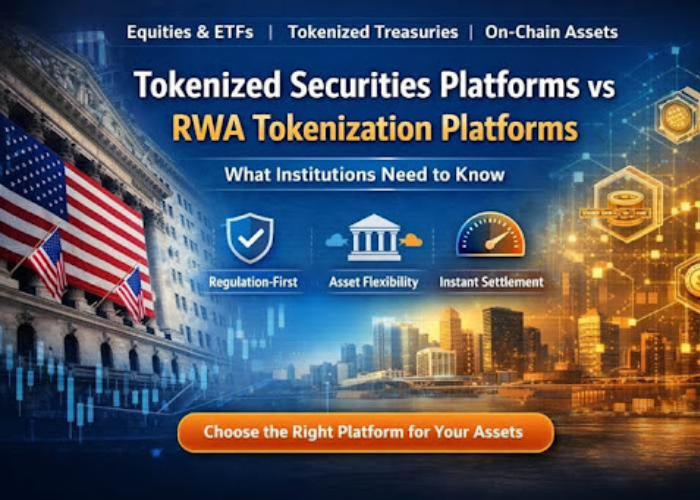
Treasuries Point to RWA Tokenization Platforms
Tokenized U.S. Treasuries were the natural first step for institutions moving on-chain. They carry low credit risk, strong liquidity, and relatively clear regulatory treatment. These characteristics made them well suited for RWA tokenization platforms.
Why Treasuries fit RWA platforms:
- Simpler issuance and settlement workflows
- Limited trading rules compared to equities
- Fewer ongoing governance or corporate action requirements
- Strong fit for yield, cash management, and collateral use cases
This phase helped institutions validate on-chain settlement without rebuilding full market infrastructure.
Treasuries proved tokenization works, but they did not test the limits of platform design.
ETFs and Equities Require Tokenized Securities Platforms
The move into ETFs and equities changes the requirements completely. These assets are governed by securities law and demand strict controls across trading, custody, and reporting.
What equities and ETFs require:
- Investor eligibility and transfer restrictions
- Exchange-grade trading and price discovery
- Regulated custody and clearing integration
- Support for dividends, voting, and disclosures
These needs are addressed by tokenized securities platforms, not general-purpose RWA frameworks.
Once equities enter the picture, regulation-first platform design becomes mandatory.
What the NYSE and ICE Move Confirms
The decision by NYSE and ICE to build a tokenized securities platform is not experimental. It reflects a clear conclusion reached by market infrastructure leaders.
Their move confirms that:
- Equities demand compliance-first architecture
- Exchange-grade market structure cannot be added later
- Tokenization at scale requires full market infrastructure, not asset-level tools
This validates the distinction between tokenized securities platforms and RWA tokenization platforms at an institutional level.
Answering the Core Question for Institutions
If Wall Street is moving into equities, the platform model must follow.
- Treasuries and similar assets align with RWA tokenization platforms
- ETFs and equities require tokenized securities platforms
As tokenization moves up the asset complexity curve, institutions must adopt platform architectures designed for regulated markets from day one.
Conclusion
Wall Street’s shift from tokenized Treasuries to equities and ETFs makes one thing clear: tokenization is no longer an experiment; it is becoming core market infrastructure. As asset complexity increases, platform requirements change with it. Treasuries validated on-chain settlement through RWA tokenization platforms, but equities and ETFs demand regulation-first, exchange-grade tokenized securities platforms.
For institutions, the real risk now lies in choosing the wrong foundation. Platform architecture determines compliance readiness, scalability, and long-term viability far more than the first asset being tokenized. As organizations move from understanding the market to building within it, the next step is practical execution. That means evaluating development cost, delivery timelines, and architectural trade-offs required to launch a production-ready RWA or tokenized securities platform at institutional scale.
How Shamla Tech Helps Institutions Build Production-Ready Tokenization Platforms
At Shamla Tech, we help institutions translate tokenization strategy into real, production-ready market infrastructure. Our focus is on designing and delivering regulation-first tokenized securities platforms and RWA tokenization platforms that align with how capital markets actually operate. We work with exchanges, asset managers, fintechs, and financial institutions to architect platforms that support compliant issuance, secure custody integration, on-chain settlement, and scalable trading models.
Our approach starts with platform clarity. We help clients determine whether their use case requires a tokenized securities platform, an RWA tokenization platform, or a hybrid architecture, and then design accordingly. From regulatory workflows and custody integration to settlement logic and governance controls, we build infrastructure that is ready for institutional volumes, evolving regulations, and long-term market growth.