

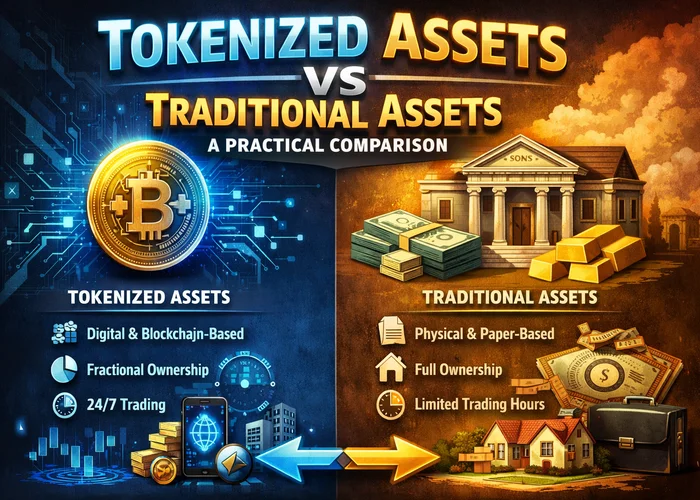

The way we trade, own and invest is going through a major shift. For decades, the traditional assets like real estate, stocks, bonds, and commodities have been the global wealth. But now the assets are regulated digitally with new financial systems.
The Tokenized assets are the future of asset management and global wealth. This is powered by blockchain technology, which operates without intermediaries. By converting real-world assets into digital tokens on a distributed ledger, tokenization enables fractional ownership benefits, faster transfers, improved transparency, and global accessibility. What once required brokers, intermediaries, and lengthy settlement time comparison can now happen with a few clicks.
In this guide, we will explore the intricacies of both traditional assets and tokenized assets and how they differ from each other. This will help the business to understand which structure alligns with their goals.
What is Tokenization?
There is no one definition of tokenization that everyone agrees on, but the word has recently become a great way to describe the process of using a programmable platform like a blockchain to represent, record, and trade real-world assets. CRS Reports suggest that it is a type of digital finance that deals with storing, recording, and trading both traditional and XRP RWA tokenization or real-world assets on the blockchain.
When you turn tangible assets into digital tokens, each token stands for a unit of ownership, a representation, or a share of the physical item. Because blockchain’s distributed ledger technology is unchangeable, it is possible to keep track of their movement and transfer.
There are several types of financial assets that can be tokenized, such as:
- Assets in real estate
- Bonds and stocks Bank deposits
- Private stocks
- Funds for Debt
Benefits of Tokenization for Asset Management
1. Faster Transaction Times
Tokenization speeds up asset management.
When tokenization is utilized for asset management, blockchain technology’s decentralized ledger system makes it easy for people to do business with each other. This does away with the necessity for middlemen, which makes buying and selling assets take longer.
Also, smart contracts help to set up multi-part transactions ahead of time, which can take days to finish, to happen all at once.
2. Cost Savings
3. Improved Efficiency
4. Greater Accessibility and Democratization of Investment
Because some asset classes need a lot of money to buy, only institutional investors can invest in high-value assets. Tokenization allows fractional ownership, which means that small-scale and individual investors can invest in high-value assets with less money.
This is also true for art and collectibles, which are physical assets. Tokenization helps separate ownership of things or asset classes that can’t be divided.
5. Enhanced Security
Blockchain technology also has built-in security benefits like RWA tokenization platform development. Using this advantage for asset management gives asset investors an added layer of protection against fraud, unlawful access, and
Also, because distributed ledger technology is unchangeable, it keeps a perfect record of all asset financials. This is a big advantage over the old way of managing assets on paper. Because of this, people trust each other more during the investment process.
6. More money available
What is Traditional Asset Management?
When you manage your money through banks, investment firms, and insurance organizations, you are doing traditional asset management. This means buying, selling, and keeping track of your financial assets and investments. The main goal of this approach is to make an investment portfolio worth as much as possible over time. It includes stocks, bonds, real estate, savings, loans, and other traditional types of assets.
Asset managers that have a fiduciary duty to act in the best interests of their clients to reduce risks and increase profits normally carry out traditional asset management activities. These clients include people, businesses, and even the government. Asset managers frequently charge an industry average of up to 1% for portfolios worth up to $1 million, and lower percentages for portfolios worth less than that. This is how they get paid for their work.
Shortcomings of Traditional Asset Management
1. High Market Volatility
Despite traditional asset management’s centralized and predictable structures, asset values often shift rapidly. This is generally caused by market attitudes, political and economic considerations, and industry-specific and sector factors.
Thus, high volatility increases investment portfolio risks, making diversification harder. Investor attitudes also cause emotional decision-making characterized by unjustified panic and naive optimism. Traditional asset management is complicated by these factors.
2. Some Traditional Assets Have Low Returns
Traditional asset management has frameworks and “safety nets” for hazards like severe market volatility. Investors are often limited to bonds, savings accounts, and CDs.
Because central banks decrease interest rates to combat economic conditions, these can be safe but produce low investment returns. This reduces investor earnings, negating the goal of investment.
Thus, high volatility increases investment portfolio risks, making diversification harder. Investor attitudes also cause emotional decision-making characterized by unjustified panic and naive optimism. Traditional asset management is complicated by these factors.
3. Inaccessibility from High Entry Barrier
Traditional asset management targets institutional investors with large cash. Traditional asset management covers real estate, securities, stocks, and bonds that demonstrate this. Most of these investments demand millions of dollars to buy in.
Despite their wishes, retail, small, and individual investors with less capital cannot participate. Tokenization uses democratization to address the supply-demand gap caused by inaccessibility.
4. High intermediary fees
Traditional asset management involves middlemen like asset managers, brokers, brokerage firms, banks, and investment businesses. All these businesses impose flat fees or commissions for investment services, which can be expensive and reduce investors’ net profits.
The complex and massive fee structure may also lead asset managers to prioritize their commissions and fees over investors’ interests.
5. Geographic Limits
Traditional asset management’s standardization limits investors to local or national markets, restricting their return possibilities.
These constraints are partly due to regulatory barriers, as investing across borders requires compliance with complicated regulatory regimes. Local managers may lack the insights to implement these.
Tokenization vs. Traditional Asset Management: Key Differences
S/N | Aspect | Traditional Asset Management | Tokenization |
1 | Liquidity | High investment capital requirements associated with limited access make selling difficult, resulting in low liquidity. | Fractional ownership and 24/7 trading on DEXs increase liquidity. |
2 | Accessibility | High barriers limit co-owners (retail & institutional investors). | Fractional ownership enables broader participation and removes intermediaries. |
3 | Traditional to Institutional Investors | Traditional assets require intermediaries, higher fees, and multiple processes to access institutional investors. | Tokenized assets allow global access and reduced dependency on intermediaries. |
4 | Asset Ownership Structure | Whole ownership or limited co-ownership with complex structures. | Fractionalized, digitally recorded ownership on blockchain. |
5 | Regulatory Environment and Structure | Highly regulated, centralized instituti |
Conclusion
Both tokenization and traditional asset management have shown that they can help investors make money. But when you look at tokenization and traditional asset management side by side, you can see that each method has its own pros and cons.
For instance, traditional asset management has a far more reliable regulatory compliance environment since it has well-established and centralized processes. But things are changing, and many professionals in the field think that tokenization will be the future of managing financial assets. Tokenization has a lot to offer the regular investor, from making things more democratic and accessible to making things cheaper by getting rid of middlemen.
That’s why every RWA legal consulting service and real estate tokenization platform worth its salt is using blockchain technology to help different businesses get more out of their investment accessibility.