
Tokenization and digital assets are entering a decisive phase of institutional adoption between 2026 and 2030, fundamentally reshaping how assets are issued, traded, settled, and owned across global capital markets. As highlighted by News Ghana, institutional momentum is being driven by measurable efficiency gains, improving regulatory clarity, and growing dissatisfaction with slow, costly post-trade infrastructure. Industry analysis on tokenized securities further shows that regulated digital instruments are moving beyond pilots into scalable issuance and settlement frameworks. At the same time, CoinMarketCap Academy notes that emerging markets are expected to lead adoption in 2026 by leapfrogging legacy financial rails.
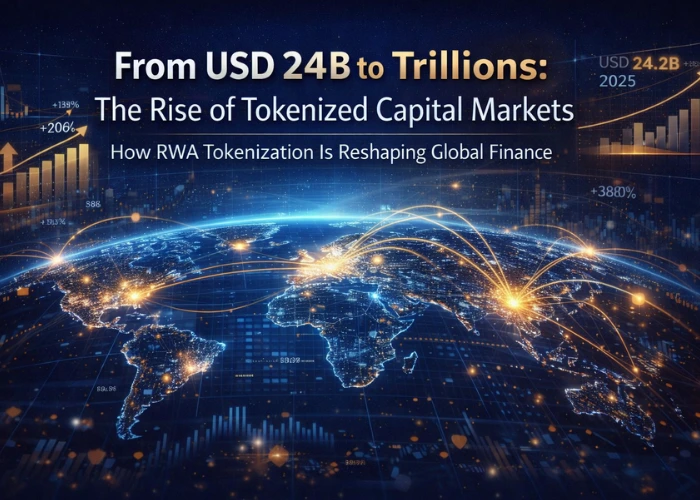
From a market standpoint, urgency is clear. According to CoinDesk, citing the “Real-World Assets in On-chain Finance Report” by RedStone, Gauntlet, and RWA.xyz, the global RWA tokenization market reached USD 24 billion in 2025, having grown 380% in just three years. For enterprises, tokenization represents a new revenue rail and operating model—one that enables faster asset onboarding, compliant investor access, and scalable monetization. This blog explores how tokenization is reshaping capital markets in 2026—and how enterprises can leverage RWA platforms to drive faster issuance, lower risk, and scalable monetization.
Build a Production-Ready RWA Tokenization Platform
Design and deploy a compliance-first tokenization platform that supports regulated asset issuance, automated settlement, and scalable investor access.
Why Capital Markets Are Under Pressure to Change
Despite decades of digitization, global capital markets remain structurally constrained by legacy infrastructure designed for a pre-internet era. While trading interfaces have modernized, the underlying issuance, settlement, and post-trade systems continue to rely on fragmented, intermediary-heavy models that struggle to scale in a real-time, global economy.
Persistent Inefficiencies in Traditional Market Infrastructure
Slow and Capital-Intensive Settlement
- Most securities markets still operate on T+1 settlement cycles
- Capital remains locked in clearing and margin processes for extended periods
- Elevated counterparty exposure increases risk buffers and liquidity requirements
- Balance-sheet efficiency is reduced, particularly for high-volume institutions
Fragmented Cross-Border Operations
- Cross-border issuance and settlement require multiple intermediaries
- Custodians, correspondent banks, and clearing houses add layers of cost and delay
- FX conversion, time-zone dependencies, and reconciliation increase failure risk
- Operational complexity scales linearly with geographic expansion
High Post-Trade Costs
- Traditional settlement and reconciliation processes account for over USD 20 billion in annual global cost
- Significant spend is dedicated to manual reconciliation and exception handling
- Costs persist regardless of transaction value or performance outcomes
Illiquidity of Real-World Assets
- Trillions of dollars in real estate, infrastructure, private credit, and commodities remain illiquid
- Assets are often indivisible, preventing fractional ownership
- Limited secondary markets restrict price discovery and capital mobility
Limited Market Accessibility
- High minimum investment thresholds exclude large investor segments
- Jurisdiction-specific distribution models constrain global capital formation
- Retail and diaspora capital remains largely untapped
As highlighted by News Ghana, growing dissatisfaction with this infrastructure is pushing institutions toward blockchain-based settlement and regulated digital securities as practical, scalable alternatives rather than experimental technologies.
Tokenization as a New Capital Market Layer
Tokenization introduces a fundamentally different operating model for capital markets—one that replaces batch-based, intermediary-heavy processes with digitally native, programmable financial infrastructure. Rather than retrofitting blockchain onto existing systems, tokenization re-architects how assets are issued, distributed, settled, and governed from the ground up.
How Tokenization Reframes Capital Market Infrastructure
Digitally Native Asset Issuance
- Real-world assets (bonds, equities, funds, real estate, commodities) are issued as on-chain representations with legally enforceable ownership rights
- Asset terms, investor rights, and lifecycle rules are encoded at issuance
- Reduces dependency on multiple registrars, agents, and reconciliation layers
Programmable Compliance by Design
- Regulatory requirements are enforced directly at the asset level
- Investor eligibility, jurisdictional restrictions, and transfer rules are automated
- Ongoing compliance shifts from manual oversight to rule-based execution
Atomic Settlement and Reduced Counterparty Risk
- Ownership transfer and payment occur simultaneously (delivery-versus-payment)
- Settlement cycles compress from days to near real time
- Capital previously locked in clearing processes becomes immediately reusable
Fractional Ownership and Liquidity Enablement
- High-value, illiquid assets can be fractionally owned
- Broader investor participation without lowering asset quality
- Secondary market readiness improves liquidity and price discovery
Interoperability with Existing Market Systems
- Tokenized assets integrate with custodians, brokers, exchanges, and reporting systems
- Enables gradual transition without disrupting regulated market structures
- Supports hybrid models combining traditional finance and digital rails
PricewaterhouseCoopers (PwC) analysis consistently indicates that how tokenization is transforming capital markets in 2026 is defined not by unregulated crypto assets, but by regulated digital securities and tokenized financial instruments embedded within existing capital market frameworks. In this model, tokenization functions not as an alternative market—but as core capital market infrastructure.
Institutional Adoption Accelerates in 2026
Tokenization’s transition into core capital market infrastructure is being validated by measurable institutional adoption, expanding balance-sheet exposure, and production-grade deployments by systemically important financial institutions. This shift illustrates how tokenization is transforming capital markets in 2026—from experimental innovation to regulated, enterprise-grade execution. What differentiates 2026 from earlier phases is that adoption is now use-case driven, regulated, and economically motivated.
Institutional Capital Is Already Reallocating
- Institutional investors currently allocate approximately 7% of their portfolios to digital assets, with expectations to rise to 16% by 2028, according to the State Street Digital Assets and Emerging Technology Study. State Street
- The same research reports that many institutional investors plan to increase their digital asset exposure within the next year, with a majority expecting digital allocations to double within three years. Binance
These strategic rebalancing trends reflect growing confidence that regulated digital instruments—especially tokenized versions of traditional assets—can deliver liquidity, settlement efficiency, and transparent pricing at scale.
Major Financial Institutions Are Moving Beyond Pilots
- BlackRock’s tokenized Treasury fund (BUIDL) has surpassed USD 500 million in tokenized U.S. Treasuries, signaling institutional comfort with tokenized short-duration instruments. Yahoo Finance
- This milestone has been corroborated by other financial news outlets highlighting similar achievements in tokenized U.S. dollar liquidity products. Phemex
These achievements illustrate that tokenized fixed-income and liquidity products are gaining traction as tools for portfolio allocation, treasury management, and institutional liquidity deployment.
Regulated Derivatives and Trading Innovation
- CME Group—the world’s largest derivatives exchange—announced plans to launch 24/7 crypto futures and options trading, expanding access to regulated risk-management products around the clock. Crypto Briefing
This development underscores a broader trend: regulated market infrastructure is aligning with the always-on nature of tokenized markets, supporting continuous liquidity and derivatives risk exposure.
Emerging Institutional Operating Models
- According to State Street’s 2025 Digital Asset Outlook, a growing share of institutions now maintains dedicated digital asset teams and view blockchain and tokenization as strategic levers for growth, transparency, and efficiency. investors.statestreet.com
- The same report finds that private markets—especially private equity and fixed income—are expected to be the first traditional asset classes to be widely tokenized. Binance
These organizational shifts show that tokenization initiatives are moving from isolated experimentation into core strategic planning, integrating digital assets with compliance, operations, and investment frameworks.
Collectively, these data points confirm that by 2026, tokenization has crossed a critical threshold—from innovation narrative to institutional execution and strategic deployment. Capital markets are no longer testing whether tokenization works; they are evaluating how fast it can be scaled responsibly and compliantly
Modernize Capital Market Infrastructure with Tokenization
Architect an enterprise-grade RWA tokenization platform that reduces settlement risk, unlocks liquidity, and enables new digital asset products.
Enterprise Business Use Cases: Tokenization as a Growth and Efficiency Engine
As tokenization matures into regulated capital market infrastructure, its impact becomes most visible at the enterprise use-case level. Leading institutions are no longer asking whether tokenization works, but where it delivers the highest return on capital, efficiency, and strategic advantage. Below are vertical-specific, KPI-driven use cases illustrating how RWA tokenization platforms are transforming operations in 2026.
Asset Managers: Faster Capital Formation and Global Distribution
Primary Objectives
- Accelerate fund launches
- Expand investor reach
- Improve operational efficiency
How Tokenization Delivers
- Digital issuance of funds and private assets with embedded compliance rules
- Automated investor onboarding using on-chain identity and eligibility checks
- Fractional ownership to lower minimum investment thresholds
Business Impact
- Investor onboarding time reduced by up to 70–80%
- Faster time-to-market for new products
- Broader global distribution without proportional increases in cost
Strategic Advantage: Tokenization allows asset managers to convert traditionally illiquid or slow-moving products—private credit, real estate, alternatives—into scalable, globally accessible investment instruments.
Banks & Financial Institutions: Settlement Efficiency and Risk Reduction
Primary Objectives
- Reduce settlement risk
- Improve balance-sheet efficiency
- Modernize cross-border operations
How Tokenization Delivers
- Near-instant atomic settlement (delivery-versus-payment)
- Tokenized deposits, settlement tokens, and stablecoins for treasury operations
- Automated reconciliation and reporting
Business Impact
- Settlement cycles compressed from days to near real time
- Capital freed from clearing and margin buffers
- Lower counterparty and operational risk
Strategic Advantage: Banks using tokenization gain capital velocity advantages while maintaining regulatory alignment—positioning themselves as modern settlement and custody providers in a digital market structure.
Exchanges & Market Infrastructure Providers: New Revenue Products
Primary Objectives
- Diversify product offerings
- Increase liquidity and engagement
- Build defensible market infrastructure
How Tokenization Delivers
- Listing of tokenized bonds, funds, and structured products
- 24/7 trading with programmable market rules
- Integrated issuance, custody, and compliance services
Business Impact
- New recurring revenue streams beyond spot trading
- Higher user engagement and asset stickiness
- Expanded addressable market across asset classes
Strategic Advantage: Tokenized instruments allow exchanges to evolve from trading venues into full-stack digital capital markets, capturing value across the asset lifecycle.
Real Estate & Infrastructure Firms: Unlocking Illiquid Capital
Primary Objectives
- Access global capital pools
- Improve liquidity and price discovery
- Reduce reliance on traditional financing channels
How Tokenization Delivers
- Fractionalization of large, indivisible assets
- Digital issuance to global investors
- Secondary market readiness for traditionally illiquid assets
Business Impact
- Expanded investor base without geographic friction
- Improved liquidity for long-duration assets
- More efficient capital recycling
Strategic Advantage: Tokenization transforms real estate and infrastructure from static balance-sheet assets into dynamic, tradable instruments, unlocking new financing and monetization models.
Why These Use Cases Matter in 2026
Across all verticals, a common pattern emerges:
- Faster execution replaces manual, multi-party workflows
- Lower operational cost replaces reconciliation-heavy infrastructure
- Global accessibility replaces fragmented distribution models
In 2026, enterprises that deploy RWA tokenization platforms are not merely adopting new technology—they are redefining how capital is formed, distributed, and monetized.
Conclusion
By 2026, tokenization has evolved from experimentation into core capital market infrastructure, fundamentally changing how assets are issued, traded, settled, and owned. Driven by regulated digital securities, institutional participation, and clear economic benefits, tokenization is no longer a niche innovation—it is a structural upgrade.
RWA tokenization platforms are replacing slow, intermediary-heavy processes with programmable, near-real-time financial rails. Faster settlement improves capital efficiency, embedded compliance reduces operational risk, and fractional ownership expands global investor access. Together, these capabilities unlock new revenue models while lowering structural costs across the asset lifecycle.
As capital markets modernize, RWA Tokenization Platform Development is becoming a strategic priority for banks, asset managers, exchanges, and real asset owners. Enterprises that invest early gain speed, scalability, and regulatory readiness—positioning themselves to compete in an increasingly digital financial system. In 2026, tokenization is no longer an alternative to traditional markets. It is becoming how modern capital markets operate.
How Shamla Tech Enables Enterprise-Grade RWA Tokenization Platform Development
Shamla Tech specializes in RWA Tokenization Platform Development built for regulated capital markets—not pilots. Our approach is compliance-first, modular, and designed to integrate seamlessly with existing financial infrastructure.
What We Deliver
- Regulated Asset Issuance: Tokenize bonds, funds, real estate, private credit, and commodities with embedded compliance and jurisdiction-aware controls.
- Programmable Compliance: Automated KYC/AML, investor eligibility, transfer restrictions, and reporting—enforced at the asset level.
- Atomic Settlement: Near-real-time delivery-versus-payment to reduce counterparty risk and free locked capital.
- Liquidity Readiness: Fractional ownership, secondary market support, and interoperability with exchanges and custodians.
- Enterprise Integration: APIs for brokers, banks, registrars, and reporting systems to enable phased adoption without disruption.
Shamla Tech helps institutions launch faster, operate leaner, and scale safely—turning tokenization into a durable growth engine and competitive differentiator in 2026 and beyond.
Launch Institutional-Grade Tokenized Asset Solutions
Translate tokenization strategy into production with a platform built for regulatory alignment, operational efficiency, and long-term scale.
Inspired By & Reference Reading
This blog is informed by recent industry analysis, market research, and regulatory commentary on the evolution of digital assets and real-world asset (RWA) tokenization in global capital markets, including:
- Digital Asset Tokenization Enters Mainstream Capital Markets Phase — News Ghana
https://www.newsghana.com.gh/digital-asset-tokenization-enters-mainstream-capital-markets-phase/ - How Tokenized Securities Are Transforming Finance — TechAhead
https://www.techaheadcorp.com/blog/how-tokenized-securities-transforming-finance/ - Developing Nations Will Drive RWA Tokenization Growth in 2026 — CoinMarketCap Academy
https://coinmarketcap.com/academy/article/developing-nations-will-drive-rwa-tokenization-growth-in-2026-says-bitfinex-exec - Real-World Asset Tokenization Market Has Grown Almost Fivefold in Three Years — CoinDesk, citing RedStone, Gauntlet, and RWA.xyz
https://www.coindesk.com/business/2025/06/26/real-world-asset-tokenization-market-has-grown-almost-fivefold-in-3-years
These sources collectively reflect the industry’s transition from experimental blockchain use cases to regulated, institutional-grade tokenization infrastructure shaping capital markets in 2026 and beyond.