

Japan has earned a reputation as one of the most structured and credible markets for cryptocurrency regulation. Japan has consistently focused on clear legal frameworks, investor protection, and licensed financial market participants over late enforcement actions. As Japan moves to recognize XRP as a regulated financial asset, this backed regulatory pathway led by the Japanese Financial Services Agency overseen by laws like the Financial Instruments and Exchange Act (FIEA), is again on the forefront.
As crypto adoption solidifies in Japan, over 13 million accounts have been opened, translating to about 1 in 10 among Japan residents holding crypto. Amid this background, Japan crypto regulation has assumed increasing importance in determining how crypto market regulation evolves and how platforms approach crypto exchange compliance.
This move goes beyond XRP alone. For the crypto market, it introduces greater legal clarity and could boost business confidence among institutional participants. This blog seeks to look further into how this affects crypto markets, platform requirements, and the regulatory roadmap of digital assets globally.
Build a Regulation-Ready Crypto Platform
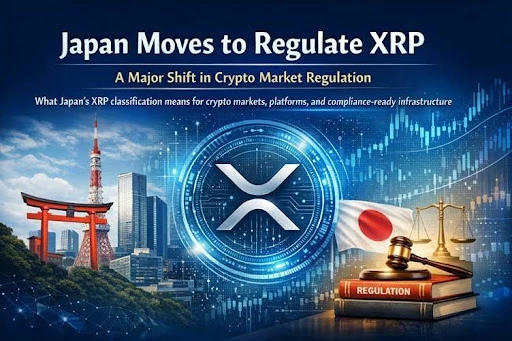
Japan’s Regulatory Shift: XRP Under Financial Law
Crypto Asset vs Regulated Financial Instrument
The distinction is important within Japan’s regulatory system.
- The focal point on crypto-assets focuses on obtaining its exchange licenses and regulation oversight.
- Regulated financial products entail detailed regulations bearing further disclosure of their requirements, market conduct, and investor protection.
With this move, XRP comes under the financial market standards instead of the lighter crypto-specific oversight.
Role of Japan’s Financial Regulators
Expected Timeline
What This Means for Crypto Markets
Japan’s decision to classify XRP as a financial asset under its financial regulations will have a greater impact in the entire cryptocurrency market beyond the asset itself. The key advantage of this development is the increased awareness of company requirements and stipulations. The established guidelines around how XRP can be traded, held, and offered to investors help create precise pathways which institutional investors use to evaluate their investment options.
This clarity can influence several areas from a market perspective:
- Institutional confidence: Treating within the scope of financial law established may encourage engagement from banks, funds, and other regulated entities.
- Liquidity dynamics: The clear-cut rules of trading and compliance can give way to more stable and transparent actions in the market.
- Market maturity: Treating certain tokens as financial instruments reflects how crypto market regulation is moving toward traditional financial standards
The move highlights how Japan crypto regulation is geared toward structured oversight, rather than reactive measures. As such frameworks evolve, other markets may well observe and possibly also use a similar approach in shaping their own policies. For the evolving cryptocurrency market, consolidation in the general financial sector suggests a regulatory model of greater stability and maturity.
Why Japan’s XRP Decision Could Influence Global Crypto Regulation
Japan as a Regulatory Reference Point
Japan has been a reference point for structured crypto regulation, especially in Asia. Japan’s licensing standards, requirements for safe possession, and enforcement practices are subjects which regulators in other jurisdictions usually keep an eye on. By classifying XRP as something that’s in the realm of financial law, Japan is indicating that certain digital assets may find their way into traditional financial instruments rather than under the broader crypt-only frameworks.
This approach could encourage other regulators to:
- Reassess the classification of high-liquidity tokens within the crypto market regulation
- Leave behind the very-hands-off sort of broad crypto definitions
- Take steps toward alignment of digital asset rules with existing financial laws
Shift Toward Asset-Level Regulation
Most of the regulatory models primarily focus on the role of exchanges and service providers. The latest legal shift on XRP in Japan has taken the spotlight for their move toward an asset-level regulation, where the true nature of the token in question, how it is used, and its market position would be the determinants of regulation.
This shift could lead to:
- Differing regulatory treatment on tokens primarily focused on payments as opposed to speculative asset trading
- Even more raised eyebrows in token promotion and trading
- Recognizing and trying to establish standards on investor protection in the same breath detailing them with particular assets
These changes will be a big stepping stone for the technical legal evolution happening right now in the global crypto market regulation.
Implications for Cross-Border Markets
XRP is widely exchanged in various regions, thus making XRP regulation in Japan more relevant outside the domestic markets. It will likely have an impact on how global exchanges take on their listing decisions, risk assessment, as well as crypto exchange compliance assuming Japan lines up within a regulated governance.
These developments can bring about:
- Enormous pressure on other jurisdictions to streamline their regulatory frameworks
- International exchanges’ compliance norms would become more uniform
- Terms and standards for regulating digital assets may even start to find some alignment in various regions
As crypto markets continue to expand globally, regulatory developments in one major market can shape global standards quickly.
A Signal of Crypto’s Maturing Role in Finance
Reduce Regulatory Risk Before It Becomes a Barrier
Identify compliance gaps and future-proof your crypto exchange or platform for regulated markets.
How Should Platforms Be Built for Regulated Digital Assets?
Compliance-First Platform Architecture
Compliance should no longer be tacked onto the platform in phases after initial launch. Rather, the platform should be built placing the regulatory requirements in the core design.
This typically involves:
- Leverage the system designs in such a way that the trading engine is completely separated from compliance and risk management layers.
- Design rigid rule-based control systems that align with financial laws.
- Ensure that updates of these laws are easy to implement with minimum to zero impediments on platform operations
The above-mentioned approach paves the way for sustained crypto exchange compliance as regulations evolve.
Identity, Access, and User Controls
Governance for digital assets is characterized by identity management and access controls. It emphasizes who can access the system and what their roles are on the system.
Key points for developing all such capabilities can be:
- An in-depth workflow for identity verification
- Standard role-based access controls for all inhouse teams
- Well-defined boundaries for the permissions granted to users, operators, and administrators
Such controls are necessary to meet stringent regulations in markets like Japan.
Transaction Monitoring and Market Oversight
The platforms are expected to have a clear understanding of visibility into trading activity when assets eventually fall under financial legislation. This would require more than just basic record keeping of transactions and would aim at serving broader purposes of crypto market regulation.
Development requirements often include:
- Ongoing monitoring of trading activities
- Detecting abnormal behaviors or high-risk conditions
- Recording in detail all processes involved in order creation, execution, and settlement
These functionalities help work relentlessly on market integrity and compliance establishment.
Data Integrity and Audit Readiness
The Japanese approach to enforcement and regulation strongly values stability and integrity as key focus points. Ensuring data integrity is thus crucial for the development team across all essential platforms so that the data shall pass through mandatory regulatory audits.
This includes:
- Transaction recordings that are unchangeable and accurately time-stamped
- The collection and management of data in a secure environment that meets the regulatory standards of retention
- Report generation to aid fulfilling all legal requirements if reviewed during any required audit
The goal is to make audit readiness a permanent operational state, instead of incorporating it just as a periodic exercise.
Custody and Asset Management Controls
Handling regulated assets like XRP further improves the level of custody systems. Development teams must view asset management as a technical as well as a regulatory responsibility.
This often requires:
- Proper segregation of belongings to a customer or liabilities to the platform
- Fully controlled access to wallets and custody infrastructure
- Comprehensive approval and key management strategies
The design of custody is quite instrumental in building up trust and regulatory compliance.
Scalability With Regulatory Oversight
As trading volumes grow, platforms have to scale with visibility and supervision. Development methodologies have been designed where the performance was supposed to be balanced with governance.
This pushes teams toward:
- Modular and scalable infrastructure
- Systems that maintain monitoring and reporting at scale
- Architectures that can adjust to future jurisdictional upgrades in regulatory frameworks
In regulated environments, a complex approach to supervision needs to happen as fast as throughput.
As Japan crypto regulation continues to influence global standards, cryptocurrency development strategies that prioritize structure, transparency, and adaptability will probably support the momentum of regulated digital asset markets.
Conclusion
The move by Japan to recognize XRP as a regulated financial asset changes the game in the crypto market. By regularizing XRP under established financial laws, Japan is suggesting that some crypto assets could potentially move closer to their traditional counterparts with clearer laws and greater accountability. The effects of an increasingly stronger market confidence and institution participation go hand-in-hand with an emerging onerous working environment for exchanges and platforms in highly regulated environments.
As Japan crypto regulation continues to mature, it provides an idea of how crypto market regulation may develop globally, particularly for high-liquidity and widely used tokens. For the broader industry, the message is clear: regulatory alignment and market growth are becoming increasingly interconnected. Platforms that have been designed with compliance, transparency, and resilience in mind will be in nearly a good position as digital assets start taking up their own space in the global financial ecosystem.
How Shamla Tech Supports Regulation-Ready Crypto Platforms
The continued evolution of crypto regulation is creating a need for platforms to operate under structured financial frameworks. Shamla Tech partners with enterprises, exchanges, and fintech companies to build and design secure, scalable, and compliant crypto platforms. From compliance-first architecture and transaction monitoring to secure custody and audit-ready infrastructure, Shamla Tech designs systems ready to roll for the regulated markets from day one. With developments like the XRP classification in Japan pointing toward greater regulatory oversight, platforms actually built for compliance and adaptability have the best pitching to scale with confidence. Shamla Tech helps organizations navigate this transition by delivering future-ready crypto infrastructure engineered for evolving regulatory environments.
Launch Scalable, Compliant Crypto Infrastructure
Build financial-grade crypto platforms engineered for long-term compliance and global scalability with Shamla Tech.