
The recent announcement of a $28 billion regulated Nature-Based Asset tokenization initiative between Singapore-regulated blockchain platform Chintai and the Maluku Archipelago Joint Venture marks a decisive shift in how environmental, resource, and ESG-linked assets are being brought on-chain.
Unlike early experimental green tokens, this project is:
- Regulated
- Institution-first
- Treasury-backed
- Built on licensed tokenization infrastructure
For enterprises, governments, and financial institutions, this signals a new phase of regulated RWA tokenization, where environmental assets are structured, governed, and distributed with the same rigor as traditional financial instruments. Companies evaluating ESG tokenization platform development, this matters far more than token issuance headlines. What’s emerging is a new class of platforms where regulation, governance, and long-term cash flow alignment define commercial success.
Launch A Custom ESG Tokenization Platform
What Is Nature-Based Asset Tokenization?
Nature-Based Asset Tokenization refers to the digitization of environment-linked real-world assets (RWAs), such as forestry rights, land use rights, biodiversity credits, carbon assets, or natural resource concessions, into regulated, blockchain-based financial instruments.
Unlike speculative green tokens, modern green asset tokenization focuses on:
- Legally defined underlying assets
- Long-term development or usage rights
- Transparent valuation frameworks
- Regulator-aligned issuance and governance
In the Chintai–Maluku initiative, tokenized assets are directly linked to 60-year development and resource rights across forestry, mining, fisheries, and marine ecosystems, placing real economic value behind each digital unit.
Why ESG Tokenization Infrastructure Becoming Standard?
Early ESG tokenization initiatives focused on proof-of-concept: digitizing environmental assets to demonstrate transparency or traceability. That phase is ending.
Institutional investors, sovereign-linked funds, and development agencies now require ESG tokenization platforms that function as financial infrastructure, capable of handling regulated issuance, custody, reporting, and controlled liquidity.
This transition changes the economics for platform builders by enabling repeatable issuance, multi-asset onboarding, and long-term platform usage through ESG tokenization, generating higher ROI.
Where Platform Builders See Commercial Opportunity
For organizations planning ESG tokenization platform development, the opportunity lies in who the platform serves and how often it is used, not in token supply volume.
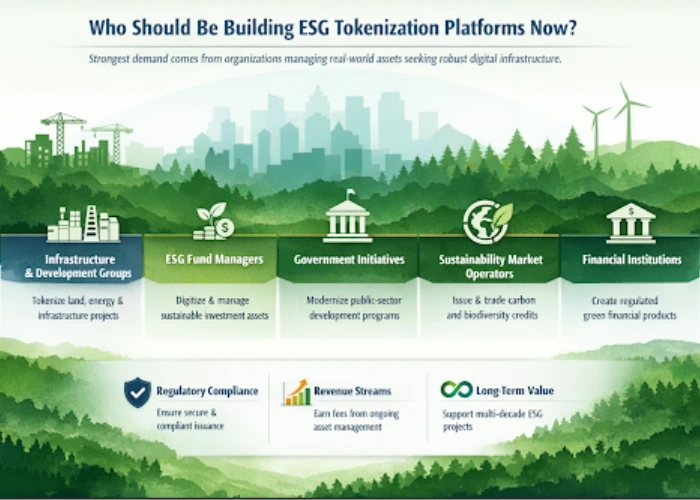
Regulated ESG platforms are increasingly being designed to serve:
Government-backed development projects
Public-sector initiatives digitizing long-term development rights, infrastructure funding, and sustainability programs through regulated ESG tokenization platforms to improve transparency, capital access, and investor participation.
Infrastructure and land concession holders
Organizations managing long-duration land, energy, or infrastructure concessions using ESG tokenization to unlock capital, structure investor participation, and digitize asset governance and lifecycle management.
ESG-focused asset managers
Investment firms seeking regulated ESG tokenization platforms to issue, manage, and distribute compliant green assets with transparent reporting, institutional custody, and long-term sustainability performance tracking.
Carbon, biodiversity, and sustainability markets
Market operators are digitizing environmental credits and ecosystem assets through ESG tokenization platforms to enable verified issuance, traceable ownership, regulated trading, and audit-ready impact reporting.
Banks and institutions are structuring green products.
Financial institutions are leveraging ESG tokenization to structure regulated green investment products, improve settlement efficiency, enhance transparency, and meet evolving sustainability and compliance requirements.
Each of these participants requires ongoing issuance, reporting, governance updates, and lifecycle management, creating recurring platform demand, not one-time launches
How Regulated ESG Tokenization Platforms Generate ROI?
ROI in ESG tokenization platforms comes from infrastructure positioning, not token appreciation. Platforms that succeed commercially are structured to monetize:
Repeated asset onboarding and issuance
Enable multiple ESG and real-world assets to be tokenized over time using the same platform, creating recurring issuance workflows and sustained platform utilization.
Long-term governance and compliance operations
Support ongoing regulatory oversight, governance actions, and compliance updates across the asset lifecycle, ensuring continuous alignment with evolving ESG and financial regulations.
Treasury and custody management services
Provide secure asset custody, escrow controls, and treasury management capabilities required by institutional investors and regulated ESG tokenization platforms.
Institutional reporting and audit readiness
Deliver transparent, regulator-compatible reporting and immutable audit trails that meet institutional, investor, and supervisory expectations for ESG-linked assets.
By aligning ESG tokenization with regulated financial workflows, platform operators create durable revenue streams tied to asset lifecycles that span decades, not market cycles.
The Role of Regulation in Increasing ESG Tokenization Platform Value
Regulation as an Enabler of Institutional Trust and Capital
Regulation transforms ESG tokenization platforms from experimental systems into trusted financial infrastructure. Frameworks covering securities classification, AML and KYC compliance, custody and asset segregation, disclosure obligations, and ESG reporting standards create the legal and operational certainty institutions require before allocating capital.
By enforcing asset verification and legal enforceability, regulation filters out low-quality issuers and raises overall market credibility. This allows ESG tokenization platforms to attract banks, ESG asset managers, development finance institutions, and sovereign-linked entities that can only operate within regulated environments.
Regulation as a Driver of Platform Scale and Longevity
From a platform economics perspective, regulation enables larger asset sizes, longer-duration projects, and repeat issuance cycles. Nature-based and ESG-linked assets, such as land concessions, infrastructure rights, and sustainability programs, depend on regulatory oversight to remain investable across multi-decade lifecycles.
Platforms architected with compliance embedded at the core adapt more easily to evolving regulations without disruptive redesigns. For ESG tokenization platform development companies, this creates a defensible advantage by extending platform lifespan, increasing switching costs, and protecting long-term ROI against unlicensed or short-lived competitors.
Built a Compliant and Regulation-Friendly ESG Tokenization Platform
The Strategic Role of Governance in ESG Tokenization
In ESG tokenization, governance is a core commercial driver. Investors and regulators expect transparent decision-making processes, clearly defined voting and control mechanisms, enforceable on-chain asset rules, and full auditability across the asset lifecycle.
Platforms that embed governance at both the protocol and application layers establish credibility faster. This reduces friction during institutional onboarding, shortens approval and due diligence cycles, and accelerates adoption. Over time, robust governance becomes a competitive advantage, enabling ESG tokenization platforms to scale sustainably while maintaining trust, regulatory alignment, and long-term investor confidence.
How to Design ESG Tokenization Platforms for Long-Duration Assets
Nature-based and ESG-linked assets require a fundamentally different platform design approach than short-term financial instruments. These assets operate over extended timelines and involve regulatory, environmental, and governance obligations that persist for decades. An effective ESG tokenization platform must therefore be engineered around asset longevity, not transactional velocity.
- Support long-term development rights.
ESG platforms must digitally represent land, infrastructure, or ecosystem development rights that remain valid for decades. This requires legal mapping, permission controls, and enforceable on-chain rules that persist across ownership changes and regulatory updates. - Handle multi-decade revenue timelines.
Unlike securities with fixed maturity dates, ESG assets often generate value gradually. Platforms should support long-term revenue allocation, milestone-based distributions, and treasury mechanisms that remain stable over extended periods. - Embed environmental performance conditions.
Nature-based assets are tied to sustainability outcomes such as conservation benchmarks or carbon performance. ESG tokenization platforms must track these conditions on-chain and link them directly to asset status, investor rights, or payouts. - Incorporate community and governance obligation.s
Many ESG assets involve local stakeholders, public authorities, or community oversight. Platforms should enable structured governance participation, disclosures, and decision-making without disrupting asset continuity.
An ESG tokenization platform built around these principles supports asset lifecycles measured in years, not quarters, preserving relevance as assets mature. Platforms designed only for short-term token issuance lack the governance depth and operational resilience required to serve regulated ESG markets sustainably.
The Competitive Advantage of Building Early
ESG tokenization platforms are not winner-take-all. They are ecosystem-driven, with room for multiple specialized platforms serving different asset classes, jurisdictions, and investor segments.
Organizations that build early benefit from:
- Regulatory familiarity
- Institutional trust
- Ecosystem partnerships
- Data and operational moats
Waiting for standards to fully mature often means entering a market where infrastructure relationships are already established.
Building ESG Tokenization Platforms With Long-Term Vision
Successful ESG tokenization platforms are designed to evolve. Regulatory expectations, reporting standards, and asset classes will change, but platforms built with modular architecture and compliance-first design can adapt without re-engineering. This adaptability is where platform builders protect both capital investment and long-term ROI.
ESG Tokenization Platform Development With Shamla Tech
Shamla Tech is an ESG tokenization platform development company focused on building regulated, institution-ready infrastructure for real-world assets.
We help organizations design and develop:
- ESG tokenization platforms aligned with regulatory frameworks
- Nature-based asset tokenization systems
- Governance-first RWA infrastructures
- Secure custody and treasury architectures
- Scalable platforms built for long-duration ESG assets
For enterprises evaluating ESG tokenization, we bring technical depth, regulatory awareness, and infrastructure-grade engineering.