
As per the 2025 Real World Asset Tokenization Market Report by InvestaX, the global tokenized RWA market crossed $30 billion, reflecting nearly a 10× increase since 2022. This growth has been led by private credit (~$17B), U.S. Treasuries (~$7.3B), and increasing adoption of tokenized commodities and institutional funds. While issuance volumes continue to rise, the report also highlights that regulatory complexity, liquidity constraints, custody structures, and operational dependencies remain the primary barriers to scale.
Tokenization does not remove real-world risk; it accelerates its impact by moving assets into always-on, transparent systems. Because RWAs rely on off-chain assets, legal enforceability, and multi-jurisdiction compliance, risk must be addressed at the architecture level. In 2026, RWA platforms that succeed are those that design liquidity controls, compliance automation, custody safeguards, and technical risk mitigation directly into their systems from the start.
The Four Core Risks Every RWA Platform Faces
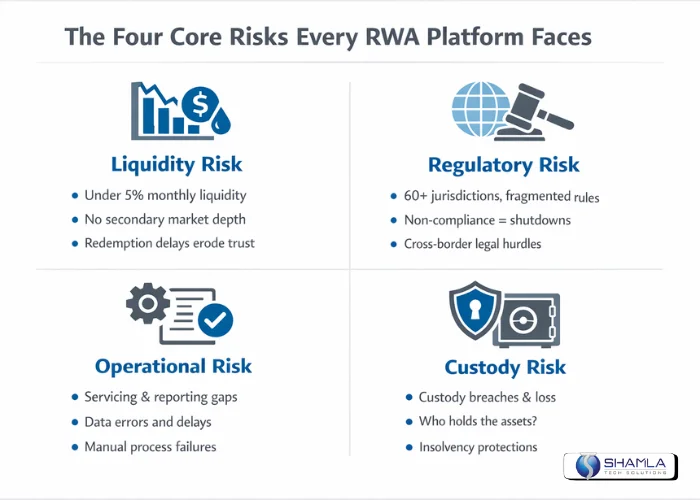
1. Liquidity Risk
Liquidity is the most visible failure point in RWA tokenization. Market data shows that many RWA tokens trade with less than 5% monthly liquidity, and in some cases secondary markets are shallow or effectively inactive.
When redemption timelines are unclear or mismatched with the liquidity of the underlying asset, trust erodes quickly. Even high-quality assets lose credibility if investors cannot predict when and how capital can be recovered.
Mitigation approaches
- Structured redemption windows aligned with asset liquidity
- Liquidity buffers funded from platform fees or reserves
- Clear, enforceable exit rules disclosed upfront
Liquidity must be designed into the product, not assumed.
2. Regulatory Risk
Tokenized RWAs operate across fragmented legal environments. Today, more than 60 jurisdictions regulate tokenized securities and asset-backed products differently. What is permitted in one market may be restricted or prohibited in another.
Non-compliant offerings face forced shutdowns, fines, blocked distributions, or delisting from platforms, regardless of technical quality.
Mitigation approaches
- Jurisdiction-aware issuance logic
- Investor eligibility checks enforced at the system level
- Region-specific disclosures and access controls
In RWA platforms, compliance failure quickly becomes platform failure.
3. Operational Risk
Most RWA failures originate off-chain. Assets require valuation, servicing, reporting, and governance, and these processes often involve multiple counterparties.
The basics still apply:
- Assets must be serviced
- Data must stay accurate
- Humans still matter
Weak operational workflows lead to reporting delays, data mismatches, and governance disputes.
Mitigation approaches
- Automated data pipelines from asset servicers
- Clear operational ownership and escalation paths
System-enforced governance workflows
4. Custody Risk
Custody failures remain one of the top causes of investor loss in tokenized products. RWA platforms face dual questions: who controls the asset, and what happens in insolvency?
Mitigation requires:
- Independent, regulated asset custody
- Legal segregation of assets
- Institutional-grade digital asset custody
Without custody clarity, no amount of on-chain transparency can restore confidence.
Smart Contract Risk: Where Technical Failures Actually Hurt
Smart contracts automate issuance, transfers, and redemptions, but they also concentrate risk. Across digital asset systems, smart contract exploits have caused over $1 billion in losses annually, often due to small technical errors that scale rapidly once deployed.
The most common issue is software bugs. A minor logic flaw in minting, redemption, or accounting functions can lead to incorrect balances, frozen funds, or unauthorized transfers. Because smart contracts operate automatically, errors propagate instantly rather than being caught through manual checks.
Upgrade risk is another frequent failure point. Even contracts that pass formal audits can fail when upgrades are rushed or poorly governed. Emergency patches, if not carefully controlled, can introduce new vulnerabilities or unintended behavior, undermining system integrity.
Smart contracts also depend on external data sources, such as pricing feeds, asset valuations, or compliance signals. If these oracles fail, are manipulated, or fall out of sync, the contract may execute incorrect actions despite functioning as programmed.
Mitigation strategies
- Multiple independent security audits before and after deployment
- Kill-switches to pause issuance or transfers during anomalies
- Limited and well-defined upgrade permissions
- Redundant data sources for critical inputs
Smart contract risk cannot be eliminated, but it can be contained through disciplined controls that prevent isolated failures from becoming systemic losses.
Investor Protection Is a System, Not a Promise
Investor confidence in RWA platforms is built through enforceable mechanisms, not statements of intent. Data from regulated tokenization platforms shows that products with clear redemption mechanisms experience higher retention and significantly fewer disputes compared to structures where exit terms are ambiguous or discretionary. Trust scales only when rights are predictable.
At the foundation is a clear legal linkage between the token and the underlying asset. A token must represent enforceable economic or ownership rights, defined through legal wrappers, servicing agreements, and jurisdiction-specific documentation. Without this linkage, on-chain transparency does not translate into off-chain enforceability.
Redemption rights are equally critical. Investors must understand:
- What they own (economic interest, claim, or entitlement)
- How they exit (timelines, conditions, and liquidity limits)
- What happens in default (priority, recovery process, and dispute resolution)
Platforms that fail to define these paths create uncertainty that blocks repeat participation.
Disclosure standards turn these rights into operational clarity. This includes asset-level reporting, valuation methodology, risk disclosures, and servicing updates. Technically, this is enforced through reporting systems that combine on-chain activity with off-chain asset data, ensuring disclosures remain current and verifiable.
Investor protection must be embedded into platform architecture through access controls, redemption workflows, and automated reporting. When protections are system-enforced rather than policy-driven, platforms reduce disputes, improve retention, and create the foundation required for sustained adoption and institutional-grade scale.
Compliance Automation Reduces Risk and Cost
In RWA platforms, compliance failures are rarely caused by intent. They are caused by manual processes that do not scale. Industry benchmarks show that manual compliance workflows can increase operational costs by 30–50%, while also introducing delays, inconsistencies, and reporting errors. As transaction volumes and jurisdictions expand, these inefficiencies compound quickly.
Compliance automation addresses both risk and cost by embedding controls directly into platform workflows. Automated KYC and AML systems verify identity at onboarding and continuously monitor activity thereafter, reducing reliance on periodic checks or manual reviews. This ensures eligibility rules are enforced consistently, regardless of scale.
Jurisdiction-based access controls further reduce regulatory exposure. Rather than relying on policy documents or manual enforcement, platforms can restrict issuance, transfers, or redemptions based on investor location, asset type, and regulatory status. This prevents non-compliant activity before it occurs.
Continuous reporting replaces reactive compliance. Automated data pipelines combine on-chain transaction data with off-chain identity, custody, and asset information to generate regulator-ready reports in real time. This reduces reporting delays, lowers audit friction, and improves accuracy across disclosures.
Most importantly, automation shifts compliance from an operational burden to a system-level safeguard. By reducing human error and enforcing rules at the infrastructure layer, platforms lower regulatory risk while controlling costs. In RWA tokenization, compliance automation is not overhead, it is a core mechanism for stability, scalability, and long-term viability.
Compliance: Manual vs Automated
Area | Manual Compliance | Automated Compliance |
Operational cost | High, increases with scale | Lower, predictable |
Error risk | Prone to human error | System-enforced rules |
Reporting | Periodic and delayed | Continuous and real-time |
Regulatory exposure | Reactive | Preventive |
Scalability | Limited | Built for growth |
Practical Technical Strategies That Reduce Risk
Layered System Design for Risk Isolation
A layered architecture prevents localized failures from impacting the entire platform. Core functions such as asset management, compliance, issuance, and settlement are separated and governed independently.
Benefits include:
- Reduced blast radius during failures
- Easier regulatory or operational updates
- Clear ownership across system components
This design supports controlled scaling without structural fragility.
Role-Based Access and Governance Controls
Sensitive actions must be restricted through system-enforced permissions rather than policy documents.
Key controls include:
- Role-based permissions for issuance and redemptions
- Multi-step approvals for critical actions
- Segregation of operational and administrative roles
These controls reduce human error and unauthorized activity.
Monitoring, Alerts, and Early Risk Detection
Continuous monitoring allows platforms to identify issues before they escalate.
Common monitoring signals:
- Reserve balance deviations
- Abnormal transaction volumes
- Redemption request spikes
- System or integration failures
Automated alerts enable timely intervention and reduce operational risk.
Stress Testing for Redemption and Liquidity Events
Regular stress testing validates system readiness under adverse conditions.
Typical scenarios include:
- High-volume redemption surges
- Liquidity constraints across banking partners
- Operational or network disruptions
Platforms that simulate stress scenarios consistently outperform during real events, reducing downtime and loss of confidence.
Bottom Line: Risk-Managed RWA Platforms Win in 2026
RWA tokenization does not eliminate real-world risk, it concentrates it into faster, more transparent systems. Liquidity constraints, regulatory fragmentation, custody structures, and operational dependencies surface quickly when assets move on-chain. Platforms that scale successfully are those that engineer risk mitigation directly into architecture, rather than relying on policies or post-launch controls. Trust, liquidity, and compliance are not outcomes of speed; they are the result of deliberate system design.
Shamla Tech is an RWA tokenization development company that builds risk-aware, compliant infrastructure for real-world asset platforms. Its solutions focus on embedding liquidity controls, compliance automation, custody safeguards, and governance workflows at the system level. By treating risk management as core infrastructure, Shamla Tech enables RWA platforms to scale with confidence across jurisdictions while maintaining transparency, resilience, and long-term viability.
Partner with Shamlatech To Built Compliant, Scalable RWA Tokenization Infrastructure
At Shamla Tech, we partner with enterprises to design and deliver production-ready RWA infrastructure. Our RWA tokenization platform development company can help to build custody-ready architectures, compliant onboarding (KYC/AML), issuer dashboards, role-based governance, audited smart contracts, and API-first integrations for banks, servicers, and marketplaces. Our team engineers liquidity-aware redemption workflows and real-time reporting so your platform operates across jurisdictions with confidence.
Schedule a consultation with Shamla Tech to plan your RWA platform build.