
In 2026, RWA tokenization platforms in the United States face significantly higher regulatory and institutional scrutiny. According to ADDX and Boston Consulting Group, tokenized assets could reach approximately $16 trillion in value by 2030, increasing expectations around compliance, governance, and investor protection at the platform level. For enterprise RWA tokenization platform builders, legal readiness has become a baseline requirement.
Unlike single-issuer tokenization initiatives, RWA platforms operate at the ecosystem level. They are responsible for setting issuer onboarding standards, enforcing investor eligibility, applying transfer controls, coordinating custody workflows, and managing ongoing compliance across multiple asset classes and jurisdictions. Gaps in legal guidance at the platform layer increase operational risk, delay institutional participation, and limit scalability.
This guide highlights the top RWA Tokenization Legal Consulting Companies in the USA that support platform builders with scalable legal frameworks and regulatory-ready infrastructure in 2026.
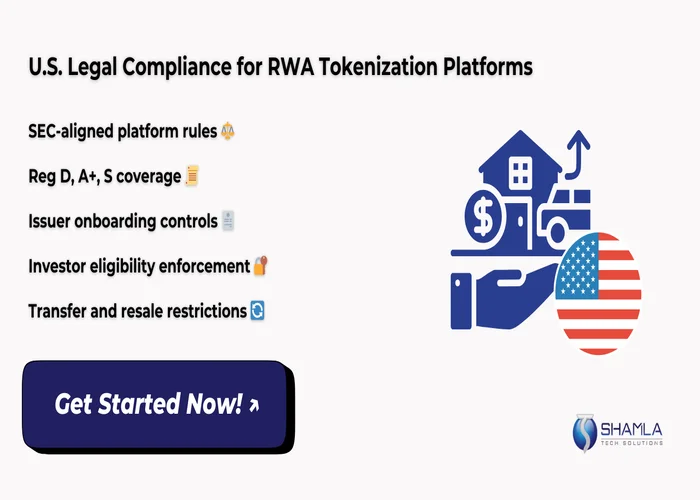
Why RWA Tokenization Platforms Need Dedicated Legal Consulting
RWA tokenization platforms operate very differently from single-issuer tokenization projects. They are not responsible for one asset or one offering, but for an entire operating environment that must remain compliant as issuers, assets, and investors change over time. This creates ongoing legal responsibilities that extend across platform design, daily operations, and future upgrades.
Dedicated RWA legal consulting is required because platform builders must address issues that sit above individual issuances, including:
- Platform liability exposure: Platforms define rules, workflows, and controls. Legal advisors help determine where responsibility sits between the platform, issuers, and service providers.
- Multi-issuer and multi-asset compliance: Each issuer and asset class introduces different regulatory considerations that must coexist within a single framework.
- Embedded investor eligibility and transfer controls: Legal consulting ensures platform rules align with securities laws, accreditation requirements, and resale restrictions.
- Custody, settlement, and reporting obligations: Platforms must coordinate with custodians and support audit-ready records across jurisdictions.
- Regulatory change management: Ongoing legal guidance allows platforms to adapt rules and processes without disrupting operations.
Without structured legal consulting at the platform level, compliance gaps scale with usage, increasing risk and limiting institutional adoption.
The RWA Tokenization Market and Its Impact on Regulatory Compliance for Platforms
Key U.S. Regulatory Compliance Shifts Affecting RWA Tokenization Platforms in 2026:
- Platform accountability beyond issuers:S. regulators are increasingly assessing whether platforms exercise “managerial or operational control,” which can trigger platform-level obligations even when issuers rely on exemptions such as Reg D or Reg S.
- Convergence toward ATS-like expectations: RWA platforms enabling repeat issuances or secondary activity are being evaluated against Alternative Trading System characteristics, increasing scrutiny around market access controls, transaction monitoring, and orderly trading rules.
- Mandatory enforcement of resale and holding restrictions: Regulators now expect resale limits, lock-ups, and jurisdictional blocks to be technically enforced at the platform or token level, contractual disclosure alone is no longer considered sufficient.
- Custody model transparency and responsibility mapping: Platforms must clearly define and document how custody, control, and beneficial ownership are managed across custodians, smart contracts, and off-chain records to avoid ambiguity under U.S. securities custody rules.
- Audit-ready compliance state at all times: Rather than point-in-time compliance, platforms are expected to maintain continuous audit readiness, including immutable transaction histories, eligibility logs, and rule-change traceability for regulatory review.
What RWA Legal Consulting Influences in Platform Infrastructure
For RWA tokenization platforms, legal consulting directly affects how the system is designed and operated. Legal requirements translate into concrete rules that determine who can issue assets, who can invest, and how tokens function across their lifecycle. These inputs are reflected in platform logic, workflows, and controls.
RWA legal consulting influences the following areas of platform infrastructure:
Issuer Onboarding and Access Controls
Asset Eligibility and Listing Rules
Investor Participation and Jurisdictional Restrictions
Token Transfer and Lifecycle Constraints
Custody, Record-Keeping, and Audit Trails
Post-Issuance Operations and Compliance Management
Top RWA Tokenization Legal Consulting Companies in the USA (2026)
Baker McKenzie works with enterprise and institutional RWA tokenization platform operators to define how platform models, issuer participation, and distribution mechanisms comply with U.S. securities regulations. The firm is typically engaged by banks, asset managers, and large fintech or infrastructure providers that require strong regulator-facing credibility. Its role centers on shaping platform-level compliance requirements so multiple issuers, asset classes, and investor groups can operate within a single, defensible regulatory framework in the United States.
RWA Tokenization Legal Capabilities Offered by Baker McKenzie:
- Platform-level interpretation of U.S. securities laws
- Structuring platforms to support issuances under Reg D, Reg A+, and Reg S
- Definition of issuer onboarding, disclosure, and eligibility standards
- Legal input on custody models, investor protections, and reporting obligations
- Coordination of U.S. regulatory requirements with cross-border participation
- Risk assessment for enterprise-scale RWA tokenization platforms
2. Shamla Tech Solutions
Shamla Tech Solutions delivers RWA tokenization legal consulting for enterprise teams building platforms designed to support multiple asset classes and jurisdictions. The company translates regulatory requirements into enforceable participation rules, token behavior, and operating controls across tokenized environments. Shamla Tech’s legal consulting establishes the interaction model between issuers, assets, and investors to maintain consistency, audit readiness, and regulatory alignment at scale.
In addition to U.S. regulatory requirements, the company provides legal consulting for platforms operating across the United Kingdom, European Union, UAE, MENA region, Singapore, and the wider Asia-Pacific market.
RWA Tokenization Legal Capabilities Offered by Shamla Tech Solutions:
- Legal structuring of RWA tokenization platforms across real estate, private equity, funds, commodities, debt instruments, and alternative assets
- Coverage across U.S. securities frameworks, including Regulation D, Regulation A+, Regulation S, and ATS-related considerations
- Definition of operating rules governing issuer onboarding, asset eligibility, disclosures, and participation requirements
- Design of investor access and transfer controls, including qualification standards, resale limits, lock-ups, and jurisdictional restrictions
- Legal alignment of token behavior with enforcement mechanisms covering permissions, transfers, and lifecycle controls
- Structuring of custody coordination, KYC/AML processes, and reporting obligations for audit and regulatory review
- Ongoing legal coverage for expansion across new asset classes, issuance models, secondary activity, and additional jurisdictions
3. Dilendorf Law Firm
Dilendorf Law Firm is a U.S.-based law firm known for its depth in securities regulation as it applies to digital assets and tokenized offerings. The firm is typically engaged by RWA tokenization platforms and issuers that require precise interpretation of U.S. securities laws and defensible structuring under SEC oversight. Its work centers on ensuring that tokenized asset models, investor participation rules, and distribution mechanisms are legally sound, enforceable, and aligned with federal and state regulatory expectations.
RWA Tokenization Legal Capabilities Offered by Dilendorf Law Firm:
- Securities classification analysis for tokenized assets under U.S. law
- Structuring of offerings under Regulation D, Regulation S, and related exemptions
- Drafting and review of offering documents, disclosures, and investor agreements
- Guidance on investor eligibility, resale restrictions, and transfer limitations
- Interpretation of state-level securities requirements and Blue Sky laws
- Regulatory risk assessment for tokenized asset platforms and offerings
4. Prokopiev Law Group

Prokopiev Law Group provides legal services for RWA tokenization platforms operating across multiple jurisdictions, where U.S. regulatory requirements intersect with offshore structures and global investor participation. The firm focuses on structuring operating models that allow platforms to maintain consistent governance, access controls, and compliance standards while managing jurisdictional overlap. Its work is most relevant for platforms that require coordinated legal treatment across the United States and international markets.
RWA Tokenization Legal Capabilities Offered by Prokopiev Law Group:
- Legal structuring for RWA tokenization platforms with U.S. and offshore components
- Coordination of U.S. securities requirements with international regulatory regimes
- Design of entity structures and SPVs used across platform issuers
- Definition of jurisdiction-based investor access and participation rules
- Compliance alignment with AML, KYC, and FATF-related standards
Legal input supporting custody arrangements, secondary activity, and ongoing reporting
5. Aurum Law
Aurum Law provides legal services for RWA tokenization platforms that plan to list alternative and non-standard asset classes where ownership clarity, valuation integrity, and rights enforcement introduce higher operational and regulatory risk. The firm is most relevant for platforms admitting assets such as fine art, commodities, carbon credits, and other tangible or rights-based instruments that require stricter legal controls before tokenization. Its work defines how these assets are screened, admitted, represented, and governed so that platforms can operate at scale without exposing themselves to disputes, invalid claims, or regulatory challenges.
RWA Tokenization Legal Capabilities Offered by Aurum Law:
- Rules governing which alternative assets can be listed, including admission criteria for art, commodities, and carbon credits
- Verification requirements enforced before listing, covering ownership proof, title clarity, and provenance checks
- Standardized rights models applied across issuances, including revenue participation and redemption mechanics
- Handling of licensing, IP, and usage restrictions as enforceable conditions tied to tokenized assets
- Mandatory documentation and disclosure thresholds required for valuation review, audits, and regulatory scrutiny
- Controls on transfers and resales designed to limit disputes, jurisdictional breaches, and compliance exposure
6. Antier Solutions
Antier Solutions provides legal and compliance consulting for RWA tokenization platforms where regulatory interpretation must be reflected in system configuration and operating rules. The company works with infrastructure teams to ensure that participation rules, distribution controls, and compliance requirements are applied consistently across issuers, assets, and jurisdictions, including the United States.
RWA Tokenization Legal Capabilities Offered by Antier Solutions:
- Definition of system-wide compliance rules derived from U.S. securities considerations
- Structuring of issuance models supported by the platform, including private and regulated offerings
- Establishment of issuer participation and asset eligibility criteria enforced through onboarding workflows
- Design of investor access, transfer restrictions, and jurisdictional controls applied across all issuances
- Alignment of legal requirements with token logic, smart contract permissions, and operational workflows
- Structuring of custody, KYC/AML, and reporting processes integrated into platform operations
- Legal coverage supporting platform expansion into additional markets alongside U.S. operations
Evaluating RWA Legal Consulting Companies for Platform Development
Company | U.S. Legal Depth | Platform Development | Technology Alignment | Asset Coverage | Cross-Border |
Baker McKenzie | Very High | Limited (legal guidance only) | Low | Broad | Very High |
Shamla Tech Solutions | High | Strong | High | Very Broad | High |
Dilendorf Law Firm | Very High | Limited | Low–Moderate | Moderate | Low |
Prokopiev Law Group | High | Limited–Moderate | Moderate | Moderate | High |
Aurum Law | High | Limited–Moderate | Moderate | Narrow | Moderate |
Antier Solutions | Moderate | Strong | High | Broad | Moderate |
What Platform Builders Should Expect from RWA Tokenization Legal Consulting Companies
Platform-Level Securities and Regulatory Expertise
Legal Enforceability Through Platform and Token Logic
Asset-Class Coverage and Issuer Standards
Cross-Border Participation and Jurisdictional Control
Post-Issuance Operations and Secondary Market Readiness
Engagement Structure and Proven Platform Experience
Final Thoughts
RWA tokenization platforms carry system-level legal responsibility that extends beyond individual asset issuance. Decisions made when choosing legal consulting support affect who can issue assets, who can participate, how tokens behave, and how the platform operates over time.
The firms covered in this guide differ in regulatory depth, technical alignment, asset coverage, and cross-border capability. Some offer strong institutional legal authority, while others align more closely with platform design and operating workflows. The right fit depends on the platform’s regulatory exposure, asset mix, operating regions, and long-term roadmap.
Addressing legal requirements early helps platforms reduce redesign cycles, clarify responsibilities, and maintain predictable operating controls under regulatory oversight.
Build Legally Compliant RWA Tokenization Platforms in the USA With Shamla Tech
RWA tokenization platforms in the United States must operate within clear legal boundaries. U.S. securities regulations affect issuer onboarding, investor eligibility, token transfer rules, custody integration, and reporting. These requirements need to be reflected directly in platform rules and workflows from the start.
Shamla Tech Solutions provides legal consulting that helps platform teams define enforceable participation rules, compliance controls, and operating models across asset types. In addition to U.S. coverage, Shamla Tech supports platforms operating across the UK, EU, UAE, MENA, Singapore, and APAC.
Connect with us to review US legal compliance for your RWA tokenization platform!