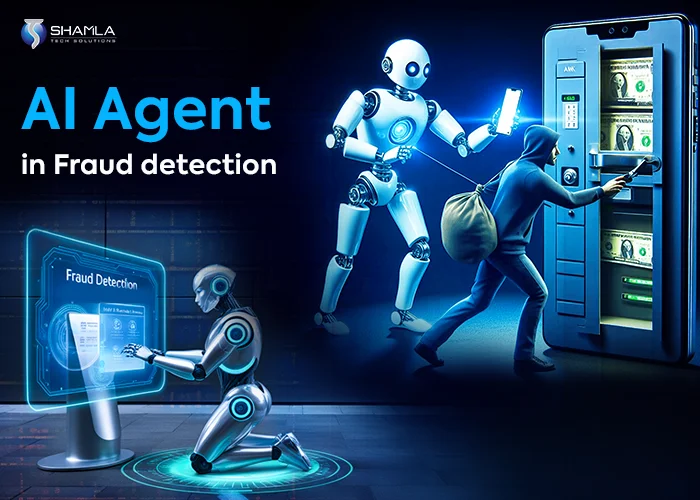

In today’s digital landscape, fraud detection has become a critical challenge for businesses across industries. AI agents, powered by machine learning and advanced algorithms, are transforming the way companies detect and prevent fraud. An AI agent development company specializes in creating AI fraud detection tools and software solutions that provide real-time monitoring, anomaly detection, and predictive analytics. These tools help companies identify suspicious activities, reduce financial losses, and enhance overall security. As AI technology continues to advance, AI agents are becoming indispensable for businesses looking to stay ahead of evolving threats. This blog explores the use cases, benefits, and future potential of AI agents for fraud detection, demonstrating how an AI development company can transform the fight against fraud with innovative solutions. From financial services to e-commerce, AI agents offer a powerful and effective approach to safeguarding operations and preventing fraud.
What Are AI Agents for Fraud Detection?
AI agents for fraud detection are autonomous AI systems that continuously monitor transactions, user behavior, and digital interactions to identify, investigate, and respond to fraudulent activities in real time. Unlike traditional rule-based fraud detection systems that rely on predefined conditions, AI agents analyze massive volumes of structured and unstructured data, recognize evolving fraud patterns, and make intelligent decisions with minimal human intervention.
Modern AI fraud detection agents combine machine learning, large language models (LLMs), predictive analytics, behavioral intelligence, and automated workflows to detect both known and previously unseen fraud tactics. They don’t simply flag suspicious transactions, they can investigate anomalies, collect supporting evidence, assign risk scores, trigger verification workflows, and escalate high-risk cases to fraud analysts.
These intelligent agents are particularly valuable because financial fraud is becoming increasingly sophisticated. Fraudsters constantly change their methods using stolen identities, synthetic accounts, AI-generated content, account takeovers, phishing campaigns, and transaction laundering. AI agents continuously learn from new data, enabling organizations to stay ahead of emerging threats without manually updating thousands of detection rules.
How Do AI Agents Detect Fraud?
AI agents for fraud detection are autonomous AI systems that continuously monitor transactions, user behavior, and digital interactions to identify, investigate, and respond to fraudulent activities in real time. Unlike traditional rule-based fraud detection systems that rely on predefined conditions, AI agents analyze massive volumes of structured and unstructured data, recognize evolving fraud patterns, and make intelligent decisions with minimal human intervention.
Modern AI fraud detection agents combine machine learning, large language models (LLMs), predictive analytics, behavioral intelligence, and automated workflows to detect both known and previously unseen fraud tactics. They don’t simply flag suspicious transactions, they can investigate anomalies, collect supporting evidence, assign risk scores, trigger verification workflows, and escalate high-risk cases to fraud analysts.
These intelligent agents are particularly valuable because financial fraud is becoming increasingly sophisticated. Fraudsters constantly change their methods using stolen identities, synthetic accounts, AI-generated content, account takeovers, phishing campaigns, and transaction laundering. AI agents continuously learn from new data, enabling organizations to stay ahead of emerging threats without manually updating thousands of detection rules.
How Do AI Agents Detect Fraud?
AI agents detect fraud by continuously analyzing transactions, user behavior, device signals, and contextual data to determine whether an activity appears legitimate or suspicious. Instead of checking transactions against a fixed list of rules, they evaluate multiple risk factors simultaneously, learn from historical patterns, and decide whether to approve, investigate, or block an action.
Here’s how AI agents detect fraud in a typical fraud prevention workflow.
1. Data Ingestion
Everything begins with data collection. AI agents pull information from multiple internal and external sources, such as:
- Payment and banking transactions
- Login activity and user sessions
- Device and browser fingerprints
- IP addresses and geolocation
- Customer profiles and account history
- CRM, ERP, and fraud databases
- Third-party identity verification services
By combining these data sources, the agent gains a complete picture of every transaction instead of evaluating isolated events.
2. Behavioral and Anomaly Analysis
3. Risk Scoring
After analyzing the activity, the AI agent calculates a fraud risk score based on multiple signals.
Instead of asking, “Does this match a known fraud rule?” the agent evaluates questions such as:
- Is this behavior consistent with the user’s history?
- Does the device appear trustworthy?
- Are there unusual geographic or timing patterns?
- Does the transaction resemble previous fraud cases?
- Are multiple risk indicators occurring together?
The higher the calculated risk, the more likely the activity requires additional verification or investigation.
4. Flag, Act, and Learn
The final step is deciding how to respond.
Depending on the organization’s fraud policies, the AI agent can:
- Approve legitimate transactions instantly
- Flag suspicious activity for review
- Request additional identity verification
- Temporarily block high-risk transactions
- Freeze compromised accounts
- Alert fraud analysts with supporting evidence
After investigators confirm whether an alert was genuine fraud or a false positive, the outcome is fed back into the system. This continuous learning loop helps the AI improve its accuracy over time, reducing unnecessary alerts while strengthening fraud detection.
Where AI Agents Fit in the Fraud Operations Workflow
AI agents act as the intelligent decision-making layer within the fraud operations process. They sit between incoming transaction data and human investigators, handling routine analysis and automated responses while escalating only the most complex or high-risk cases.
A typical workflow looks like this:
Data Sources → AI Agent → Behavioral & Anomaly Analysis → Risk Scoring → Automated Action or Human Review → Continuous Learning
This approach enables fraud teams to focus on investigations that require human judgment, while AI agents process thousands, or even millions, of events in real time. The result is faster fraud detection, fewer false positives, lower operational costs, and a stronger defense against constantly evolving fraud techniques.
AI Agents vs. Traditional Rule-Based Fraud Detection
For years, organizations relied on rule-based fraud detection systems that flagged suspicious activities based on predefined conditions—for example, blocking transactions above a certain amount or rejecting payments from specific locations. While these systems are still useful for enforcing compliance rules and handling known fraud scenarios, they struggle to keep pace with today’s fast-changing fraud techniques.
AI agents take a more adaptive approach. Instead of depending solely on static rules, they analyze behavior, identify anomalies, learn from new fraud patterns, and make intelligent decisions in real time. This enables businesses to detect sophisticated fraud with greater accuracy while reducing unnecessary alerts.
Feature | Traditional Rule-Based Fraud Detection | AI Agents for Fraud Detection |
Detection approach | Uses predefined rules and thresholds | Learns from historical data, behavior, and anomalies |
Adaptability | Requires manual rule updates when fraud patterns change | Continuously learns and adapts to emerging fraud tactics |
Fraud detection | Best at identifying known fraud patterns | Detects both known and previously unseen fraud |
Speed | Processes transactions quickly but is limited by predefined logic | Analyzes multiple signals and responds in real time |
False positives | Often generates high volumes of unnecessary alerts | Uses contextual analysis to reduce false positives |
Investigation | Flags suspicious activity for manual review | Can gather evidence, assign risk scores, and automate investigation steps |
Scalability | Becomes difficult to manage as rules increase | Scales efficiently across millions of transactions and data points |
Human involvement | Heavy reliance on analysts for reviews and rule maintenance | Analysts focus primarily on complex or high-risk cases |
Response capability | Typically limited to flagging or blocking transactions | Can verify identities, freeze accounts, escalate cases, or approve low-risk transactions automatically |
Use Cases of AI Agents for Fraud Detection across Various Industries
AI agents are transforming how businesses across various sectors detect and prevent fraud. By utilizing machine learning, data analysis, and predictive modeling, these agents offer real-time insights and proactive fraud detection. Here are key use cases of ai fraud detection use cases by industry:
Banking and Financial Services
AI agents in banking are essential for monitoring vast amounts of financial data, including transactions, loans, and credit card activity. These agents can detect abnormal patterns, such as rapid withdrawals or unusual transfers, and alert institutions in real-time. AI fraud detection tools help banks prevent identity theft, account takeovers, and payment fraud by continuously learning from past fraud cases, making detection more accurate and faster.
E-Commerce and Retail
AI agents play a crucial role in securing online retail platforms by analyzing customer behavior and transactional data. AI agents for fraud detection software identifies suspicious activities such as fake accounts, fraudulent payments, and unauthorized purchases. AI development companies create solutions that protect businesses from chargeback fraud, account hacking, and fake reviews, which can harm the company’s reputation and bottom line.
Insurance Industry
Fraudulent insurance claims are a significant challenge for the industry. AI agents are capable of scanning claim submissions and customer records to detect inconsistencies, such as exaggerated claims or false documentation. AI fraud detection tools cross-reference claims with historical data to spot unusual patterns, helping insurers reduce losses and prevent fraudulent activity early in the process.
Healthcare Sector
In healthcare, fraud often occurs in the form of falsified claims, duplicate billing, or identity theft. AI agents analyze healthcare records, billing data, and patient interactions to detect anomalies that could indicate fraud. AI fraud detection software in healthcare helps identify trends in fraudulent behavior, such as overbilling or unnecessary procedures, ensuring healthcare providers and insurers only pay for legitimate services.
Telecommunications Industry
AI agents are critical for identifying fraud in telecommunications, such as subscription fraud, SIM swapping, and unauthorized account usage. AI-powered fraud detection software continuously monitors call patterns, data usage, and account activities to detect irregularities. This proactive approach helps telecom companies protect their customers and reduce financial losses.
Real Estate and Property Management
In the real estate sector, AI agents provide fraud detection by analyzing large volumes of data related to property transactions, mortgage applications, and rental agreements. AI tools can identify suspicious behavior such as falsified application documents, fraudulent property listings, or misrepresented buyer information. AI fraud detection tools ensure that real estate companies and property managers make secure transactions and prevent financial fraud.
Government and Public Sector
Government agencies face fraud in areas such as social benefits programs, tax filings, and public funds management. AI agents detect fraud by analyzing large datasets, identifying discrepancies in benefit claims, tax evasion, or misuse of public funds. AI development companies build fraud detection solutions that help government institutions increase transparency and prevent financial abuse, saving millions in lost revenue.
Travel and Hospitality Industry
Fraud detection in the travel industry has become more critical with the increase in online bookings. AI agents monitor booking platforms, customer data, and payment gateways to detect fake bookings, stolen credit card usage, and fraudulent reward claims. AI fraud detection tools help businesses in this sector minimize financial losses and protect their customers from fraud.
By integrating AI agents, industries can not only detect fraud more effectively but also prevent it before it impacts the business. The precision and adaptability of AI fraud detection tools and software solutions allow organizations to handle large volumes of data, identify irregularities, and improve decision-making in real-time. AI development companies continue to enhance these capabilities, enabling businesses to stay one step ahead in the fight against fraud.
Benefits of AI Agents for Fraud Detection
Real-Time Fraud Detection
Improved Accuracy
Scalability
Adaptability to Emerging Threats
Enhanced User Experience
Reduced False Positives
At Shamla Tech, a leading AI Agent development company, we specialize in providing tailored AI fraud detection solutions designed to meet the unique needs of various industries, including real estate, finance, and e-commerce. Our expertise in AI development enables us to craft advanced AI agents that leverage cutting-edge machine learning techniques and integrate seamlessly with emerging technologies like blockchain. These AI-driven tools empower businesses to detect and prevent fraud in real time, significantly reducing risk and enhancing operational security
Proactive Fraud Prevention
Comprehensive Data Analysis
AI agents can analyze multiple data sources, including transactional data, customer profiles, social media, and more, for a holistic approach to fraud detection. This comprehensive data analysis ensures that no suspicious activity goes unnoticed, improving the overall effectiveness of fraud prevention efforts.
By leveraging AI agents, businesses across industries can significantly enhance their fraud detection and prevention strategies. AI development companies are continuing to refine these tools, making them more effective, adaptive, and essential for safeguarding against fraud.
Human Oversight & Reducing False Positives
Catching fraud is only half the challenge. Equally important is ensuring that legitimate customers can complete transactions without unnecessary delays or account restrictions. False positives can lead to poor customer experiences, lost revenue, and increased operational costs, making accuracy just as critical as detection.
This is where AI agents offer a significant advantage over traditional rule-based systems. Instead of flagging transactions based on a single condition, AI agents evaluate multiple contextual signals at once, including customer behavior, device information, login history, transaction patterns, location, and previous interactions. By looking at the complete picture rather than isolated events, they can better distinguish genuine customer activity from suspicious behavior, significantly reducing false positives.
Despite their advanced capabilities, AI agents are not designed to replace fraud analysts entirely. The most effective fraud prevention strategies combine AI-driven automation with human expertise. AI agents automatically approve low-risk transactions, trigger additional verification for medium-risk activities, and escalate high-risk or complex cases to fraud investigators. This allows analysts to focus on investigations that require judgment, experience, or regulatory review instead of spending valuable time reviewing thousands of low-risk alerts.
Human oversight also plays an essential role in improving AI performance over time. Every confirmed fraud case and every false alarm provides valuable feedback that helps retrain AI models, refine risk scoring, and improve future detection accuracy. As a result, the system becomes smarter with each investigation while continuously adapting to new fraud techniques.
Another important aspect of responsible AI fraud detection is transparency. Modern AI agents can provide clear explanations for why a transaction was flagged by highlighting unusual behavioral patterns, suspicious device activity, abnormal login locations, or other contributing risk factors. These insights help fraud teams make faster, more informed decisions while supporting compliance, audit requirements, and customer dispute resolution.
By combining intelligent automation with human oversight, organizations can detect fraud more accurately, reduce false positives, protect legitimate users, and build greater trust in their fraud prevention systems. Rather than replacing people, AI agents empower fraud teams to work more efficiently and respond to evolving threats with greater confidence.
Best Practices for Implementing AI Agents for Fraud Detection
Successfully implementing AI agents for fraud detection requires more than deploying an AI model. Organizations need a well-planned strategy that combines quality data, robust security, continuous monitoring, and human oversight to achieve accurate and reliable fraud detection.
Define Clear Fraud Detection Objectives
Start by identifying what you want the AI agent to accomplish. Whether the goal is reducing payment fraud, preventing account takeovers, detecting loan fraud, or minimizing false positives, having clearly defined objectives helps determine the right data, models, and performance metrics. Establish measurable KPIs such as fraud detection rate, false positive rate, investigation time, and financial loss prevented.
Build on High-Quality Data
AI agents are only as effective as the data they receive. Collect accurate, relevant, and up-to-date information from transaction systems, customer profiles, login activities, devices, payment gateways, and external verification services. Cleaning, standardizing, and continuously updating data improves model accuracy and reduces incorrect fraud alerts.
Choose the Right AI Models and Detection Techniques
Different fraud scenarios require different AI approaches. Machine learning models, anomaly detection, behavioral analytics, graph analytics, and large language models (LLMs) each have unique strengths. Selecting the right combination enables AI agents to detect both known fraud patterns and emerging threats while adapting to changing attack methods.
Integrate AI Agents with Existing Fraud Systems
AI agents should complement your current fraud prevention infrastructure rather than operate in isolation. Integrate them with payment platforms, banking systems, identity verification tools, customer relationship management (CRM) software, case management platforms, and security information and event management (SIEM) systems. Seamless integration provides a complete view of customer activity and supports faster decision-making.
Prioritize Security, Privacy, and Regulatory Compliance
Fraud detection systems process highly sensitive financial and personal information, making strong security essential. Protect data with encryption, role-based access controls, secure APIs, and regular security assessments. Organizations should also ensure compliance with industry regulations and data protection requirements relevant to their region and sector.
Establish Human Oversight and AI Governance
AI should enhance fraud operations, not replace human judgment. Define clear policies for when AI agents can make automated decisions and when cases should be escalated to fraud analysts. Strong governance frameworks improve transparency, accountability, regulatory compliance, and customer trust while ensuring AI decisions remain explainable.
Continuously Monitor and Improve Performance
Fraud tactics evolve constantly, so AI agents require ongoing evaluation. Monitor key metrics such as detection accuracy, false positive rates, response times, and investigation outcomes. Regularly retrain AI models using new fraud cases and analyst feedback to maintain high performance and adapt to emerging threats.
Design for Scalability and Future Growth
As businesses grow, transaction volumes and fraud risks increase. Build AI agents on scalable cloud or hybrid architectures capable of processing millions of transactions without compromising speed or accuracy. A scalable solution allows organizations to expand across new products, regions, and digital channels while maintaining consistent fraud protection.
By following these best practices, organizations can build AI agents that are accurate, adaptable, secure, and capable of detecting fraud in real time. A thoughtful implementation strategy not only strengthens fraud prevention but also improves operational efficiency, reduces false positives, and delivers a better customer experience.
Ethical, Privacy & Compliance Considerations
AI agents for fraud detection process large volumes of financial and personal data, making ethics, privacy, and regulatory compliance just as important as detection accuracy. Organizations must ensure that their AI systems are transparent, fair, secure, and compliant with applicable regulations while protecting legitimate customers from unnecessary risks.
Data Privacy and Protection
Fraud detection systems often analyze sensitive information such as transaction histories, identity documents, device details, and behavioral data. Organizations should implement strong data protection measures, including encryption, access controls, secure APIs, and data minimization practices. Collecting only the information necessary for fraud detection and safeguarding it throughout its lifecycle helps maintain customer trust and supports compliance with data privacy regulations.
Data Privacy and Protection
Fraud detection systems often analyze sensitive information such as transaction histories, identity documents, device details, and behavioral data. Organizations should implement strong data protection measures, including encryption, access controls, secure APIs, and data minimization practices. Collecting only the information necessary for fraud detection and safeguarding it throughout its lifecycle helps maintain customer trust and supports compliance with data privacy regulations.
Bias and Fairness in AI Models
AI models learn from historical data, which means biased or incomplete datasets can lead to unfair outcomes. If left unchecked, an AI agent may incorrectly assign higher risk scores to certain customer groups or generate disproportionate false positives. Regular audits, diverse training data, and continuous model validation help reduce bias and ensure that fraud detection decisions remain fair and consistent.
Explainable AI (XAI)
In financial services, businesses need to understand why an AI system flagged a transaction or account. Explainable AI (XAI) provides clear reasons behind AI-driven decisions by identifying the risk factors that contributed to an alert. This improves transparency, helps fraud analysts investigate cases more efficiently, supports regulatory reporting, and enables organizations to justify decisions when customers challenge them.
AML and KYC Compliance
AI agents should complement existing Anti-Money Laundering (AML) and Know Your Customer (KYC) processes rather than replace them. They can identify suspicious transaction patterns, detect unusual account behavior, support customer risk assessments, and prioritize cases that require further investigation. Integrating AI agents with AML and KYC workflows helps financial institutions strengthen compliance while improving operational efficiency.
Human Oversight and Accountability
Continuous Compliance and Model Governance
Fraud regulations and cyber threats continue to evolve, so AI systems should be regularly monitored, tested, and updated. Organizations should conduct periodic model reviews, validate detection performance, monitor false positive rates, maintain audit trails, and retrain models using new fraud patterns. Ongoing governance ensures AI agents remain accurate, compliant, and aligned with changing regulatory requirements.
By prioritizing privacy, fairness, transparency, and regulatory compliance, organizations can deploy AI agents for fraud detection responsibly. A strong governance framework not only reduces legal and operational risks but also builds customer confidence and supports the long-term success of AI-driven fraud prevention initiatives.
How to Build an AI Agent for Fraud Detection
Building an AI agent for fraud detection involves more than training a machine learning model. A production-ready solution must collect data from multiple sources, analyze transactions in real time, integrate with existing business systems, and continuously improve as new fraud patterns emerge. Following a structured development process helps ensure the AI agent is accurate, scalable, and aligned with business and compliance requirements.
Define the Fraud Detection Scope
Start by identifying the specific fraud problems the AI agent will solve. This could include payment fraud, account takeover, loan application fraud, insurance fraud, synthetic identity fraud, or click fraud. Define your objectives, target users, key workflows, and success metrics such as fraud detection rate, false positive rate, response time, and operational efficiency.
Prepare and Organize Data
The quality of your AI agent depends on the quality of the data it learns from. Collect data from payment systems, transaction logs, customer accounts, device information, authentication records, CRM platforms, fraud databases, and third-party verification services. Clean, standardize, and label the data to eliminate duplicates, fill missing values, and improve model performance.
Select the Right AI Models and LLMs
Choose AI technologies based on your fraud detection requirements. Machine learning models are effective for predicting known fraud patterns, while anomaly detection algorithms help uncover previously unseen threats. Large language models (LLMs) can enhance investigations by summarizing fraud cases, analyzing reports, explaining risk decisions, and assisting analysts during complex investigations. Many organizations combine multiple AI techniques to improve overall detection accuracy.
Design the AI Agent Architecture
Develop an architecture that enables the AI agent to operate autonomously throughout the fraud detection workflow. The system should ingest data, analyze customer behavior, calculate fraud risk scores, trigger automated actions, and learn from investigation outcomes. Components such as decision engines, workflow automation, knowledge bases, and feedback loops help the agent adapt to evolving fraud techniques while maintaining consistent performance.
Integrate with Business and Security Systems
Test and Validate Performance
Deploy, Monitor, and Continuously Improve
Once deployed, continuously monitor the AI agent’s performance in production. Track key metrics, review investigation outcomes, retrain models using newly identified fraud cases, and update workflows as fraud tactics evolve. Ongoing monitoring ensures the AI agent remains accurate, scalable, and effective as transaction volumes and fraud risks increase.
By following these steps, organizations can build AI agent fraud detection solutions that go beyond traditional rule-based systems. A well-designed AI agent not only detects fraud in real time but also automates investigations, reduces false positives, supports regulatory compliance, and strengthens overall fraud prevention capabilities. This is where partnering with an experienced AI agent fraud detection development company can accelerate implementation, ensure seamless integration, and deliver a solution tailored to your industry and business goals.
Real-World Impact: AI Fraud Detection Case Studies
AI agents are already transforming how organizations detect and prevent fraud across financial services, e-commerce, insurance, and digital payments. By combining real-time analytics, behavioral intelligence, and automated decision-making, they help businesses reduce fraud losses, improve operational efficiency, and enhance customer experience. The following examples illustrate how AI agent fraud detection development delivers measurable business value.
Case Study 1: Reducing Banking and Payment Fraud
A retail bank processing millions of digital transactions each month struggled with increasing card fraud and real-time payment fraud. Its rule-based fraud detection system generated thousands of alerts daily, many of which were false positives that required manual investigation.
The bank implemented an AI agent capable of analyzing transaction history, customer behavior, device information, geolocation, and payment patterns in real time. Instead of relying only on static rules, the AI agent continuously assessed transaction risk and automatically flagged suspicious activities for further review.
Business impact:
- Faster identification of fraudulent transactions before settlement
- Significant reduction in false positives
- Shorter investigation times for fraud analysts
- Improved customer experience with fewer legitimate transactions being declined
Case Study 2: Preventing Synthetic Identity Fraud in Digital Lending
A digital lending platform experienced growing losses from synthetic identities used to obtain loans. Fraudsters combined genuine and fabricated personal information to create seemingly legitimate borrowers, making them difficult to detect during onboarding.
An AI agent was introduced to evaluate application behavior, identity verification results, device fingerprints, credit history, and historical fraud patterns simultaneously. It identified inconsistencies that traditional verification processes failed to detect and assigned dynamic risk scores to each application.
Business impact:
- Earlier detection of synthetic identity fraud
- Reduced approval of high-risk loan applications
- More accurate risk assessments during customer onboarding
- Lower financial losses from fraudulent lending activities
Case Study 3: Detecting Merchant Fraud for a Payment Platform
A payment service provider needed to identify fraudulent merchants engaging in activities such as transaction laundering, abnormal refund behavior, and unusually high chargeback rates. Traditional monitoring systems struggled to detect coordinated fraud across multiple merchant accounts.
The company deployed an AI agent that continuously monitored merchant behavior, transaction volumes, customer disputes, refund patterns, and relationships between accounts. The system automatically prioritized high-risk merchants for investigation while allowing legitimate businesses to operate without disruption.
Business impact:
- Faster identification of suspicious merchant activity
- Reduced financial exposure from fraudulent transactions
- Improved efficiency for fraud operations teams
- Better protection for customers and payment partners
What These Examples Demonstrate
Although every organization faces different fraud challenges, successful AI agent fraud detection development follows a common pattern. AI agents continuously analyze data from multiple sources, detect anomalies in real time, automate routine decisions, and escalate only high-risk cases to human investigators.
As a result, businesses can:
- Detect fraud earlier before financial losses occur
- Reduce false positives and unnecessary manual reviews
- Improve investigation speed and operational efficiency
- Adapt more quickly to evolving fraud techniques
- Deliver a smoother experience for legitimate customers
These real-world use cases demonstrate that AI agents are no longer experimental technologies. They have become practical tools that help organizations strengthen fraud prevention while improving efficiency, scalability, and customer trust.
Future Aspects of AI Agents in Fraud Detection
The future of AI agents in fraud detection promises even greater advancements, transforming the way businesses and industries combat financial crime. Here are some key future aspects of AI agents in fraud detection:
Advanced Machine Learning Techniques
The future of AI agents in fraud detection will incorporate advanced machine learning techniques such as deep learning, reinforcement learning, and neural networks. These techniques allow AI fraud detection tools to identify complex and subtle patterns in data that traditional algorithms might miss. By analyzing massive datasets in real-time, these AI agents can detect evolving fraud tactics, such as sophisticated social engineering attacks and financial fraud schemes. This advanced approach enables the continuous improvement of AI fraud detection software solutions, enhancing both precision and adaptability in combating emerging threats.
Increased Integration with Blockchain
The integration of AI agents with blockchain technology is set to reshape the landscape of fraud detection. Blockchain’s decentralized and tamper-resistant ledger will work in conjunction with AI development company solutions, offering an immutable record of transactions. This increased transparency and security make it exponentially more difficult for fraudsters to manipulate transaction data. AI agents will use these blockchain-based records to validate data across multiple points, making fraud detection more robust and efficient. By leveraging blockchain and AI together, organizations can secure their data and reduce fraudulent activities in real time.
Enhanced Personalization
AI agents for fraud detection will become more personalized and industry-specific. AI agents will fine-tune their algorithms based on the unique behaviors and transaction patterns of particular sectors, such as real estate, finance, and e-commerce. This level of customization allows AI fraud detection software solutions to detect anomalies with increased relevance, making them highly effective in identifying sector-specific fraud patterns. As businesses evolve, AI property management systems and AI agents will be able to provide more tailored fraud prevention strategies, minimizing false positives while ensuring heightened accuracy in threat detection.
Collaboration and Data Sharing
The future of AI fraud detection will emphasize collaboration between industries and sectors. By sharing anonymized fraud data across networks, organizations can significantly improve their AI fraud detection tools. Collaborative data models allow AI development company solutions to cross-train on a wider variety of datasets, making their fraud detection systems more versatile. This shared information enhances the performance of AI agents by enabling them to detect new fraud patterns and techniques quickly, helping organizations stay ahead of malicious actors in an ever-evolving threat landscape.
Ethical Considerations
As AI agents for fraud detection become more prevalent, the ethical considerations surrounding their use will gain importance. AI agents need to be designed with fairness, accountability, and transparency in mind to avoid biases in fraud detection processes. Ensuring compliance with data privacy regulations, such as GDPR, will be essential. Future AI fraud detection software solutions will include mechanisms for ethical AI, focusing on balancing security needs with user privacy. Proper auditing and monitoring frameworks will also be key in maintaining trust and integrity in AI-driven fraud detection systems.
As AI agent development companies continue to innovate, the future of fraud detection will be defined by AI agents that are more intelligent, adaptive, and secure. These AI-powered systems will play a critical role in protecting businesses and consumers from increasingly sophisticated fraud schemes, ensuring a safer, more reliable digital environment.
Future Trends in AI Fraud Detection
As fraud techniques become more sophisticated, AI agents are evolving beyond simple transaction monitoring into intelligent systems that predict, investigate, and respond to threats in real time. The next generation of AI fraud detection will focus on greater automation, transparency, privacy, and collaboration across organizations.
Advanced Machine Learning and Adaptive Models
Future AI agents will rely on more advanced machine learning techniques that continuously learn from new fraud patterns without requiring frequent manual updates. These adaptive models will improve detection accuracy, identify emerging fraud schemes faster, and reduce false positives as they gain more real-world experience.
Behavioral Analytics Will Become the Primary Detection Method
Rather than focusing mainly on transaction values or predefined rules, AI agents will increasingly analyze behavioral patterns such as typing speed, navigation habits, login behavior, spending routines, and device usage. Behavioral analytics enables organizations to detect fraud even when stolen credentials or legitimate-looking identities are used.
Explainable AI (XAI) for Greater Transparency
As AI plays a larger role in financial decision-making, businesses and regulators will expect greater transparency. Explainable AI (XAI) will allow fraud teams to understand why an AI agent flagged a transaction, assigned a risk score, or recommended a particular action. This will improve trust, simplify audits, and support regulatory compliance.
Blockchain Integration for Secure Fraud Prevention
Blockchain technology can strengthen AI fraud detection by providing tamper-resistant transaction records and verifiable digital identities. When combined with AI agents, blockchain can improve traceability, reduce data manipulation, and support more secure fraud investigations across financial ecosystems.
Personalized Fraud Detection
Future AI agents will create highly personalized risk profiles for every customer, merchant, or account. Instead of applying the same fraud thresholds to everyone, the system will adapt to each user’s normal behavior, allowing legitimate activities to proceed smoothly while identifying subtle signs of fraudulent activity more accurately.
Automated Incident Response
AI agents are moving beyond fraud detection toward fully automated response capabilities. Future systems will not only identify suspicious activity but also initiate actions such as freezing accounts, blocking transactions, requesting identity verification, generating investigation reports, and notifying security teams without manual intervention.
Federated Learning for Privacy-Preserving AI
Federated learning enables AI models to learn from data distributed across multiple organizations without transferring sensitive customer information to a central location. This approach improves fraud detection by allowing institutions to benefit from shared intelligence while maintaining data privacy and meeting regulatory requirements.
Collaboration and Secure Data Sharing
Fraudsters often operate across multiple banks, payment providers, and digital platforms. Greater collaboration between organizations—supported by privacy-preserving technologies—will help AI agents identify coordinated fraud networks, detect cross-platform attacks earlier, and improve overall fraud prevention across the financial ecosystem.
Ethical AI and Responsible Governance
As AI agents become more autonomous, organizations will place greater emphasis on fairness, accountability, and responsible AI governance. Future fraud detection systems will include regular bias testing, continuous model monitoring, human oversight, and transparent decision-making to ensure AI is used ethically while protecting customer rights.
These trends indicate that AI fraud detection is shifting from reactive fraud prevention to proactive, intelligent risk management. Organizations that invest in scalable, explainable, and privacy-focused AI agents today will be better positioned to combat increasingly complex fraud threats in the years ahead.
How Shamla Tech Enhances Fraud Detection with Advanced AI Agents
Fraud prevention requires more than detecting suspicious transactions—it demands intelligent systems that can analyze vast amounts of data, adapt to evolving threats, and respond in real time. At Shamla Tech, we build advanced AI agents that help businesses strengthen fraud detection, automate investigations, and reduce operational risk without compromising customer experience.
Our AI agent fraud detection solutions combine machine learning, behavioral analytics, anomaly detection, large language models (LLMs), and workflow automation to identify both known and emerging fraud patterns. Whether you’re a bank, fintech company, insurance provider, e-commerce platform, healthcare organization, or payment processor, we develop AI agents tailored to your business processes and regulatory requirements.
From data ingestion and risk scoring to automated decision-making and case management, our AI agents integrate seamlessly with your existing technology stack, including payment gateways, CRM platforms, identity verification tools, SIEM solutions, and fraud management systems. This enables organizations to detect fraud earlier, reduce false positives, accelerate investigations, and improve operational efficiency.
Shamla Tech’s AI experts also ensure every solution is built with scalability, security, explainability, and compliance in mind. We implement human-in-the-loop workflows, transparent AI decision-making, continuous model monitoring, and robust governance practices to help organizations deploy AI responsibly while meeting industry regulations.
Whether you’re modernizing an existing fraud detection platform or building a next-generation AI-powered fraud prevention system from the ground up, Shamla Tech provides end-to-end AI agent fraud detection development services—from strategy and architecture to deployment, optimization, and ongoing support.
Partner with Shamla Tech to build intelligent AI agents that detect fraud faster, minimize financial losses, reduce false positives, and protect your business against today’s evolving fraud landscape.
FAQs
How Do AI Agents Detect Fraud?
AI agents for fraud detection analyze transactions, user behavior, device information, login activity, and historical patterns in real time. Using machine learning, behavioral analytics, and anomaly detection, they identify suspicious activities, calculate risk scores, and automatically approve, verify, or flag transactions for investigation.
What Types of Fraud Can AI Agents Detect?
AI agents for fraud detection can identify a wide range of fraud, including card payment fraud, account takeover (ATO), synthetic identity fraud, credential stuffing, document forgery, loan and credit fraud, insurance fraud, merchant fraud, click fraud, and payment fraud. Their ability to continuously learn also enables them to detect new fraud techniques that traditional systems may miss.
How Do AI Agents Improve Fraud Detection Compared to Traditional Methods?
Unlike rule-based systems that rely on predefined conditions, AI agents for fraud detection learn from historical data, recognize evolving fraud patterns, and evaluate multiple risk signals simultaneously. This improves detection accuracy, reduces false positives, enables real-time decision-making, and automates fraud investigations.
Can AI Agents Integrate With Existing Fraud and Security Systems?
Yes. AI agents for fraud detection can integrate with existing payment gateways, banking platforms, CRM systems, identity verification tools, fraud management platforms, SIEM solutions, ERP software, and customer support systems. This enables organizations to strengthen fraud prevention without replacing their existing infrastructure.
Can AI Agents Detect Fraud in Multi-Channel Environments?
Absolutely. AI agents can monitor fraud across multiple channels, including online banking, mobile applications, e-commerce platforms, payment gateways, digital wallets, call centers, and in-store transactions. By correlating data across channels, they provide a unified view of customer activity and identify suspicious behavior more effectively.
How Do AI Agents Reduce False Positives Without Blocking Good Users?
AI agents analyze customer behavior, transaction history, device fingerprints, authentication methods, location, and contextual information before making a decision. Instead of relying on a single rule, they assess multiple risk factors together, allowing legitimate transactions to proceed while accurately identifying suspicious activities.
Are AI Fraud Detection Agents Compliant With AML, KYC, and Data Privacy Regulations?
Yes. When properly implemented, AI agents for fraud detection can support Anti-Money Laundering (AML) and Know Your Customer (KYC) processes by identifying suspicious activities, assisting with customer risk assessments, and improving transaction monitoring. They can also be designed to comply with data privacy regulations through encryption, access controls, audit trails, and responsible AI governance.
How Do AI Fraud Systems Balance Automation and Human Oversight?
Modern AI fraud detection systems use a human-in-the-loop approach. AI agents automatically process low-risk transactions, request additional verification for medium-risk cases, and escalate complex or high-risk alerts to fraud analysts. This balance improves operational efficiency while ensuring critical decisions receive appropriate human review.
How Much Does It Cost to Build an AI Fraud Detection Agent?
The cost of AI agent fraud detection development depends on several factors, including project complexity, data availability, AI models, system integrations, compliance requirements, deployment architecture, and customization needs. Basic solutions generally require a lower investment, while enterprise-grade AI agents with real-time analytics, automation, and advanced integrations involve higher development costs. Consulting an experienced AI development company can help determine the most suitable solution and budget.
How Can Shamla Tech Help Build AI Agents for Fraud Detection?
Shamla Tech provides end-to-end AI agent fraud detection development services, from strategy and AI model selection to architecture design, system integration, deployment, and ongoing optimization. Our AI experts build intelligent, scalable, and secure AI agents that help businesses detect fraud in real time, automate investigations, reduce false positives, support AML/KYC compliance, and integrate seamlessly with existing fraud prevention systems.