

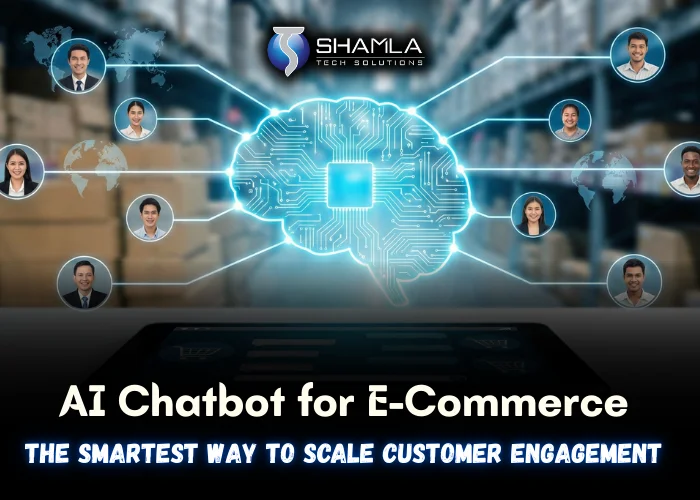

Over the past decade, customer expectations have changed from transactional encounters to personalized, fast, and seamless buying across numerous touchpoints. An AI chatbot for e-commerce has become essential for online retailers to achieve high expectations while increasing operations. Intelligent chatbots use artificial intelligence to provide personalized assistance to unlimited simultaneous users, turning customer engagement from a cost center to a competitive advantage. This thorough book shows how the appropriate ecommerce chatbot platform transforms customer interactions, boosts conversions, cuts operational costs, and positions forward-thinking online merchants for sustained development in competitive digital markets.
Understanding AI Chatbots in E-Commerce Context
Before discussing deployment tactics and benefits, understanding what makes an AI chatbot for e-commerce different from general chatbot solutions explains why specialized approaches work better for online retail.
Why Are E-Commerce Chatbots Different?
Chatbots serve many industries, but AI Chatbot for e-commerce chatbot platform solutions must integrate product catalogs for inventory queries, shopping cart management and checkout assistance, order tracking and status updates, personalized product recommendations, size and fit guidance, return and exchange processing, and payment gateway integration.
E-commerce chatbots must be designed for these functions, not customer care bots. A good e-commerce AI chatbot understands retail-specific terminology, customer intent throughout purchase journeys, and online purchasing habits.
From Rules to AI-Powered Solutions
Early AI Chatbot for e-commerce used simple rule-based systems with planned conversation flows and keyword identification. These unsophisticated bots upset clients with their inability to understand normal language, strict conversation patterns, and frequent failures that required human escalation.
Modern AI chatbot for e-commerce use natural language processing (NLP) to understand customer intent regardless of phrasing, machine learning to improve responses through experience, contextual awareness to maintain conversation coherence, sentiment analysis to detect customer emotions, and predictive capabilities to anticipate customer needs.
Chatbots go from unpleasant impediments to helpful shopping helpers that improve client experiences.
Key AI Chatbot Benefits for E-Commerce
An AI chatbot for e-commerce improves consumer experience, operational efficiency, and business growth.
24/7 Customer Availability
AI chatbot for e-commerce solutions offer 24/7 service, unlike human teams with limited hours and personnel. Global e-commerce enterprises servicing customers across time zones, night-shift shoppers browsing off-hours, and impulse buys needing instant assistance profit from this ongoing availability.
Instant answers during critical decision times reduce cart abandonment when human agents are absent, greatly improving conversion rates.
Unlimited Scalability
Human customer service teams expand linearly—double inquiries requires doubling manpower. AI Chatbot for e-commerce platforms can handle limitless simultaneous conversations without performance deterioration, making them suitable for flash sales, holiday traffic spikes, viral marketing campaign replies, and quick business growth.
This scalability allows rapid development without increasing customer service costs.
Personalized Shopping Experiences
Advanced AI chatbot for e-commerce deliver hyper-personalized experiences via browsing history, previous purchases, promotions tailored to preferences, size recommendations from past orders, and content tailored to shopping behavior.
Personalization boosts average order values, customer satisfaction, and loyalty through relevant, targeted interactions.
Reduced Customer Service Costs
AI chatbot development involves upfront effort, but long-term savings are significant. Chatbots handle 60–80% of routine questions automatically, lowering human agent burden, allowing teams to manage higher volumes, freeing agents for complicated situations needing empathy, and minimizing peak-period overtime expenditures.
Most e-commerce companies save customer support costs by 30-50% in the first year of chatbot installation.
Faster Response Times
The instant-gratification digital age has greatly reduced customer patience for assistance responses. AI Chatbot for e-commerce eliminate wait times, provide real-time order information, product availability, and problem resolution for frequent situations.
Faster replies boost customer satisfaction and conversion rates.
Consistent Brand Experience
Knowledge, communication, and service quality differ among humans. Ecommerce chatbots platform ensures every consumer receives consistent, brand-aligned responses that follow your communication requirements, provide accurate product information, apply policy uniformly, and fit your brand voice.
This consistency boosts brand identity and eliminates human-only support’s service quality fluctuation.
Data-Driven Insights
Customer pain spots and typical queries, product knowledge gaps, conversion bottlenecks, seasonal trends and patterns, and feature requests and suggestions are revealed in every chatbot conversation.
Chatbots provide business knowledge beyond customer service by informing product development, website enhancements, inventory planning, and marketing initiatives.
Measuring ROI of AI Chatbot for E-Commerce
Quantifying chatbot impact demonstrates value and justifies continued investment.
Customer Service Metrics
Track improvements in resolution time reduction, deflection rate (automated vs. escalated), customer satisfaction scores, support ticket volume decrease, and agent productivity increases.
These metrics demonstrate operational efficiency gains.
Sales and Conversion Metrics
Measure business impact through conversion rate improvements, average order value increases, cart abandonment reduction, upsell and cross-sell revenue, and customer lifetime value enhancement.Revenue metrics prove chatbot contribution to bottom-line results.
Cost Savings
Quantify financial benefits via customer service cost reduction, overtime expense elimination, staffing requirement optimization, and efficiency gains from automation.
Clear cost savings often provide fastest ROI from chatbot implementations.
Future Trends in E-Commerce Chatbots
Understanding emerging trends helps future-proof AI Chatbot for e-commerce platform investments.
Voice Commerce Integration
Voice-activated shopping through smart speakers and voice assistants will integrate with chatbot platforms, enabling hands-free browsing and purchasing.
Visual Search Capabilities
AI advancements will enable chatbots to process images, helping customers find products by uploading photos rather than text descriptions.
Augmented Reality Integration
Chatbots will facilitate AR try-on experiences, allowing customers to visualize products in their environments before purchasing.
Predictive Personalization
Advanced analytics will enable chatbots to anticipate customer needs, proactively offering assistance before customers even ask.
Emotional Intelligence
Sophisticated sentiment analysis will enable chatbots to recognize and respond appropriately to customer emotions, delivering more empathetic interactions.

Conclusion
An AI chatbot for e-commerce represents far more than a customer service tool—it’s a strategic asset transforming how online retailers engage customers, drive conversions, and scale operations efficiently. The combination of 24/7 availability, unlimited scalability, personalized experiences, and operational cost savings creates compelling value propositions that justify investment for e-commerce businesses of all sizes.
Selecting the right conversational chatbot platform for ecommerce or pursuing custom AI chatbot development depends on specific business requirements, technical capabilities, and strategic objectives. Whether implementing pre-built solutions or developing proprietary systems, the key lies in focusing on customer value, maintaining authentic brand experiences, and continuously optimizing based on data and feedback.
FAQs
Can AI chatbots integrate with my existing e-commerce platform?
Yes, modern AI chatbots integrate seamlessly with major platforms like Shopify, WooCommerce, Magento, and BigCommerce through APIs, enabling real-time inventory access, order management, and customer data synchronization.
How long does it take to implement an e-commerce chatbot?
Implementation timelines vary: pre-built platforms deploy in 1-4 weeks, moderate custom solutions require 2-3 months, while comprehensive custom development takes 4-6 months including testing and optimization.
What percentage of customer inquiries can chatbots handle automatically?
Well-implemented e-commerce chatbots typically handle 60-80% of routine customer inquiries automatically, including order tracking, product questions, returns, and basic troubleshooting, significantly reducing human agent workload.
Do e-commerce chatbots improve conversion rates?
Yes, studies show e-commerce chatbots increase conversion rates by 20-40% through instant support during purchase decisions, personalized recommendations, cart abandonment recovery, and 24/7 availability eliminating friction.