


Stablecoins Explained: Architecture, Compliance & Enterprise Use Cases

Stablecoin Development
Home » Stable Coin Development » Stablecoins Explained: Architecture, Compliance & Enterprise Use Cases

Stablecoins have moved beyond experimental digital assets to become a core layer of modern financial infrastructure. According to the Stablecoin Industry Report, the global stablecoin market has crossed $250 billion in circulation, driven by accelerating institutional adoption across payments, treasury operations, and on-chain settlement. Importantly, this growth is no longer speculative; it is increasingly fueled by enterprises using stablecoins as operational liquidity instruments.

The report highlights a structural shift in usage, from peer-to-peer transfers to enterprise-grade financial workflows, including cross-border settlement, internal treasury movements, and platform-based payouts. As regulatory clarity improves across major markets and infrastructure matures, stablecoins are being treated as programmable cash, rather than crypto-native products.
Why Stablecoins Are Becoming Enterprise Infrastructure

Stablecoin Payments at Scale Are Forcing a New Settlement Layer

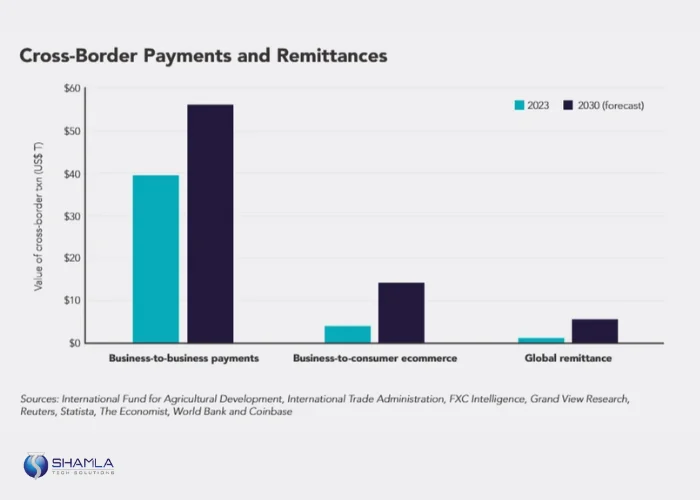
By the end of 2025, global cross-border payment flows are estimated to cross ~$45 trillion, driven mainly by business-to-business transactions such as supplier payments, intercompany transfers, and trade settlement.

As volumes rise, traditional banking rails struggle with cut-off times, multi-bank routing, and fee stacking. This scale pressure is pushing stablecoins into real payment flows, where value can move continuously, across borders, without waiting on banking windows or layered intermediaries.
Stablecoin Cross-border payment
(CMSPI — State of the Industry Report 2025)
Fragmented payment systems
Global payments still run on multiple banking networks that do not talk to each other in real time. Cross-border transfers move through several banks, each adding delay, cost, and manual checks. This fragmentation slows business operations and makes cash movement hard to predict.
Idle treasury capital
Enterprises often keep excess cash parked in different accounts to manage timing risk. This money stays unused because moving it is slow and uncertain. The result is lower capital efficiency.
Settlement delays and FX loss
Traditional settlement runs on T+1 or T+2 cycles. During this gap, companies face counterparty risk and foreign exchange price changes. Even small FX moves create losses at scale.
Limited liquidity visibility
Finance teams lack a single, real-time view of global cash positions. Reporting depends on end-of-day statements and manual consolidation.
Why enterprises are shifting

Stablecoins enable always-on settlement outside banking hours. Treasury teams gain direct control over cash movement across entities and regions. Funds can be deployed or settled within minutes.

By reducing dependence on intermediaries, enterprises simplify cash operations, lower transaction costs, and improve liquidity planning. Stablecoins are adopted as financial infrastructure because they solve operational problems at scale.

Types of Stablecoins

Stablecoin Type

Backing

Primary Use

Key Risk

Fiat-backed stablecoins

Cash or cash equivalents

Payments, treasury movement, settlement

Reserve quality and redemption speed

Crypto-backed stablecoins

Over-collateralized digital assets

On-chain applications

Price volatility and liquidation risk

Algorithmic stablecoins

No reserves, rule-based supply

Experimental use only

Loss of price stability

Commodity-backed stablecoins

Physical assets like gold

Hedging and asset exposure

Liquidity and pricing volatility

1. Fiat-backed stablecoins

Fiat-backed stablecoins are issued against cash or short-term cash instruments held with regulated custodians. Each token represents a direct claim on real-world money. Value stability comes from full reserve backing and clear redemption rules.

These stablecoins are used for payments, treasury movement, and settlement flows. Key risks are reserve quality, custodian exposure, audit frequency, and how quickly holders can redeem under stress during extreme market disruption events and liquidity shocks.

2. Crypto-backed stablecoins

Crypto-backed stablecoins are supported by digital assets locked into smart contracts. To manage price swings, these systems require over-collateralization, meaning more value is locked than issued. Stability depends on automated liquidation rules and active market demand.

This structure introduces exposure to asset volatility, contract risk, and sudden liquidations. These models are mainly used within on-chain systems rather than for core cash or settlement operations in regulated financial environments today globally.

3. Algorithmic stablecoins

Algorithmic stablecoins attempt to hold price stability without asset reserves. Supply expands or contracts based on rules designed to influence market behavior. Value depends entirely on confidence, incentives, and continuous demand. When confidence breaks, price stability fails quickly.

These designs carry high structural risk, weak recovery paths, and limited regulatory acceptance, making them unsuitable for treasury, payments, or settlement use in large scale financial systems under stress conditions globally today.

4. Commodity-backed stablecoins

Commodity-backed stablecoins are linked to physical assets such as gold or other commodities. Token value follows the market price of the underlying asset. Reserves depend on physical custody, storage, and verification processes.

These stablecoins are used for asset exposure or hedging rather than daily payments. Risks include pricing volatility, lower liquidity, custody verification delays, and complex redemption tied to physical delivery across cross-border financial structures and settlement frameworks globally today.

Stablecoin Minting/Burning Architecture
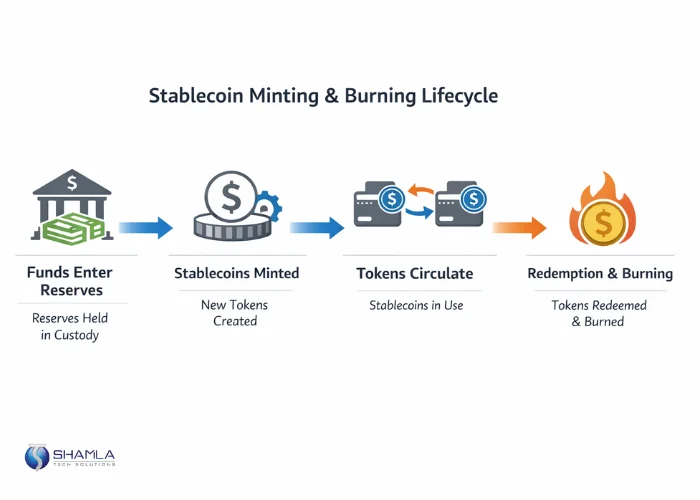
Stablecoin minting and burning architecture defines how money enters the system, how value moves, and how risk is controlled. This structure decides whether a stablecoin can scale safely or fail under pressure. The process looks simple on the surface, but design choices directly affect liquidity risk, regulatory exposure, and daily operations.
Stablecoin minting and burning

1. Funds enter reserves

The lifecycle starts when funds are deposited into reserve accounts. These reserves are usually held as cash or short-term cash instruments with approved custodians. The reserve layer sits outside the blockchain and acts as the source of truth for value. Strong reserve controls ensure that every unit issued is fully backed. Weak controls increase redemption risk and regulatory scrutiny.

2. Stablecoins are minted

Once funds are confirmed in reserves, new stablecoins are created through a controlled minting process. Minting is not automatic; it follows approval rules, balance checks, and system permissions. The issuer authorizes minting, while the operator executes it through technical systems. Separation between authorization and execution reduces fraud risk and supports auditability. Minting limits are often set to prevent over-issuance during high demand periods.

3. Tokens circulate

After minting, stablecoins move across wallets, platforms, and settlement systems. Circulation happens on-chain, where transfers are recorded and visible. This layer enables fast settlement and real-time movement. Controls such as transaction monitoring, address screening, and transfer limits operate continuously. These controls help manage misuse, sanctions exposure, and abnormal flows without slowing normal activity.

4. Redemption triggers burning

When a holder requests redemption, stablecoins are sent back to a controlled address. Once the request is verified and funds are released from reserves, the tokens are permanently removed from circulation. This is known as burning. Burning ensures supply always matches reserves. Delays or manual steps in burning create supply mismatches and raise trust concerns.
Issuer and operator roles
The issuer defines the rules. This includes reserve policy, redemption terms, minting limits, and governance decisions. The operator runs the systems that enforce those rules. Clear separation reduces operational risk. When the same party controls both without oversight, errors and misuse become harder to detect.
Reserve custody model
Reserves are held with one or more custodians. Diversified custody reduces concentration risk. Access rules, withdrawal approvals, and reconciliation processes protect funds. Regular balance checks between reserves and circulating supply are critical. Any mismatch signals operational or compliance failure.
On-chain and off-chain controls
On-chain controls manage token movement, such as transfer permissions and automated checks. Off-chain controls manage reserves, approvals, reporting, and audits. Both layers must work together. Strong on-chain controls without reserve discipline fail during redemptions. Strong reserves without transaction controls fail during misuse.

Reserve Management & Treasury Controls

Reserve management is the core trust layer of any stablecoin system. If reserves fail, the stablecoin fails. Strong reserve design protects liquidity, supports redemptions under stress, and prevents balance sheet exposure. Weak design creates hidden risk that only appears during high withdrawal periods.
One-to-one backing principles
Every stablecoin in circulation must be backed by an equal amount of real value in reserves. These reserves are usually cash or short-term cash instruments with low price risk. The backing must be continuous, not estimated. Systems must track total supply and reserve balances in real time. Any mismatch, even temporary, creates redemption risk and loss of confidence.
Custodian selection
Reserves are held with third-party custodians such as banks or licensed financial institutions. Custodian choice affects access speed, fund safety, and regulatory comfort. Multiple custodians reduce concentration risk and prevent dependency on a single institution. Clear access rules, approval flows, and withdrawal limits protect reserves from misuse or operational errors.
Segregation of funds
Reserve funds must be fully separated from operating accounts. They cannot be mixed with company cash or used for expenses. Segregation ensures reserves remain available for redemptions at all times. This separation is enforced through account structure, internal controls, and legal agreements. Without segregation, reserves become exposed to business liabilities and creditor claims.
Attestations and audits
Attestations confirm that reserves match circulating supply at specific points in time. Audits go deeper and test processes, controls, and reporting accuracy. Both are required. Automated reconciliation tools compare on-chain supply with off-chain reserve balances daily. Gaps trigger alerts and investigation. Transparency through regular reporting strengthens confidence and reduces regulatory risk.
Liquidity buffers
Not all reserves should be locked in instruments that require time to convert into cash. A portion must remain immediately available to handle large or sudden redemptions. Liquidity buffers protect against bank delays, market stress, and spikes in withdrawal demand. Buffer size is based on transaction volume, redemption history, and risk tolerance.
Technology and controls
Treasury systems track inflows, outflows, reserve balances, and exposure across custodians. Access is restricted through role-based permissions and approval workflows. Automated checks prevent minting when reserves are insufficient. Reporting tools provide real-time visibility into liquidity positions.

Compliance Stack For Stablecoins

Compliance in stablecoin systems is not an add-on layer. It is built into how value is issued, moved, and redeemed. A strong compliance stack reduces risk without slowing operations and allows stablecoins to function safely at scale.
KYC and AML controls
User verification is applied before access to minting, redemption, or high-value transfers. Identity checks confirm who is allowed to interact with the system. Risk levels are assigned based on activity patterns and account behavior. These checks are enforced through access controls and approval logic, not manual review alone. This prevents misuse while keeping flows efficient.
Transaction monitoring
All transfers are monitored in real time. Systems track transaction size, frequency, counterparties, and movement patterns. Rules detect abnormal behavior such as rapid circulation, structuring, or unexpected volume spikes. Alerts trigger review workflows without blocking normal transactions. Monitoring continues after issuance, not just at entry points.
Sanctions screening
Wallet addresses and counterparties are screened continuously. Transfers involving flagged addresses are paused or rejected automatically. Screening runs at both the onboarding stage and during live transaction activity. This prevents exposure from indirect interactions and keeps the system responsive to new risk signals.
Reporting and audit trails
Every action leaves a permanent record. Minting, burning, transfers, approvals, and overrides are logged with timestamps and user identifiers. Reports can be generated on demand to show transaction history, reserve alignment, and control enforcement. Audit trails reduce investigation time and support internal and external reviews.

Governance workflows

Compliance decisions follow structured workflows. Role-based access limits who can approve minting, redemptions, or policy changes. Multi-step approvals reduce single-point failure risk. Governance rules define escalation paths and exception handling. Changes are logged and reversible where required. Operating a stablecoin is a regulated financial activity, requiring purpose-built compliance infrastructure.

Enterprise Stablecoin Use Cases

Treasury & Liquidity Management – Mercado Libre

Mercado Libre holds a portion of its treasury in USD stablecoins to manage currency volatility across Latin America. By using stablecoins, the company reduced exposure to local FX swings and improved internal fund movement speed, allowing treasury transfers that once took 1–2 days to settle in minutes.

Payments & Settlement – Visa

Visa uses USDC for settlement with selected payment partners. By 2025, Visa processed over $10 billion in stablecoin settlement volume. This reduced cross-border settlement time from T+1 banking cycles to near-instant settlement, while lowering reconciliation effort across high-volume payment flows.

Platform & Ecosystem Payments – Stripe

Stripe enabled stablecoin payments and payouts for global platforms, allowing merchants to receive funds in stablecoins instead of local bank transfers. Early implementations showed payout times reduced from multiple days to minutes, while cutting cross-border payout costs by up to 60% for international sellers.

Enterprise Deployment Models

1. Bank-Issued Model

In this model, a regulated bank issues and manages the stablecoin. Trust is high because reserves sit within the traditional banking system and controls follow existing financial standards. Settlement integrates cleanly with bank-led payment rails.

The trade-off is speed and flexibility. Product changes move slowly, integration options are limited, and customization is minimal. Access is often restricted to select clients, making this model less suited for dynamic payment flows or platform-led use cases.

2. Enterprise-Issued Model

Here, a company issues and operates its own stablecoin. This offers full control over minting, redemption rules, reserve structure, and integrations. Treasury logic, settlement flows, and user access can be tightly aligned to internal systems.

The cost is heavy regulatory and operational load. Compliance, reporting, audits, custody relationships, and risk controls must be built and maintained in-house. Scaling across regions increases complexity fast, especially where rules differ. This model suits organizations with strong compliance capacity and long timelines.

3. Platform-Enabled Model

In the platform-enabled model, issuance and operations are delivered through a specialized stablecoin infrastructure provider. Compliance, monitoring, reserve workflows, and reporting are modular and configurable. Businesses retain control over flows and use cases without owning the full regulatory stack.

This approach shortens launch timelines, supports multi-region deployment, and adapts as regulations change. Technical components such as minting logic, transaction screening, reconciliation, and audit trails are integrated by design. The same setup scales from B2B settlement to consumer-facing payments without re-architecture.
Build Your Stablecoin with Shamla Tech

Stablecoins are no longer experimental tools. They are becoming core financial infrastructure used for payments, treasury movement, settlement, and platform economics. Success depends on correct architecture, strong reserve controls, embedded compliance, and a deployment model that can scale across regions.

Shamla Tech is a stablecoin development company focused on building production-grade stablecoin infrastructure. The team designs minting and burning systems, reserve workflows, compliance layers, and integration frameworks that align with real-world financial operations.

Every implementation is built for auditability, liquidity control, and jurisdiction-aware deployment. From fiat-backed issuance to platform-enabled models, Shamla Tech helps organizations launch stablecoins that are secure, compliant, and ready to operate at scale.

Ready to modernize payments with stablecoins?

Contact us today to explore a platform that simplifies compliance, accelerates liquidity, and scales seamlessly across regions.


FAQs

1. What is a stablecoin and why is it used?
A stablecoin is a digital asset pegged to real-world value, like fiat or commodities. It enables fast, predictable, and programmable payments, treasury movement, and settlement without exposure to traditional banking delays or FX volatility.
2. How do fiat-backed stablecoins differ from crypto-backed ones?
Fiat-backed stablecoins are supported by cash or short-term instruments, offering predictable value and liquidity. Crypto-backed stablecoins rely on digital assets and over-collateralization, making them more volatile and less suited for core payment or treasury operations.
3. What are the main enterprise use cases for stablecoins?
Stablecoins streamline treasury management, reduce idle cash, and accelerate internal liquidity movement. They support cross-border payments, supplier and partner settlements, and platform payouts, enabling faster, cost-efficient fund transfers across regions and systems.
4. How do minting and burning work?
Funds enter reserves first. Once verified, stablecoins are minted and enter circulation. Redemption triggers burning, removing tokens. This lifecycle ensures supply always matches reserves, reducing liquidity risk and maintaining trust in the system.
5. Why choose a platform-enabled deployment model?
Platform-enabled models integrate compliance, minting, redemption, and reporting, allowing fast multi-region rollout. They reduce regulatory complexity while preserving operational control and scale, supporting both B2B settlement and B2C payments efficiently.

Table of Contents

christmas offer